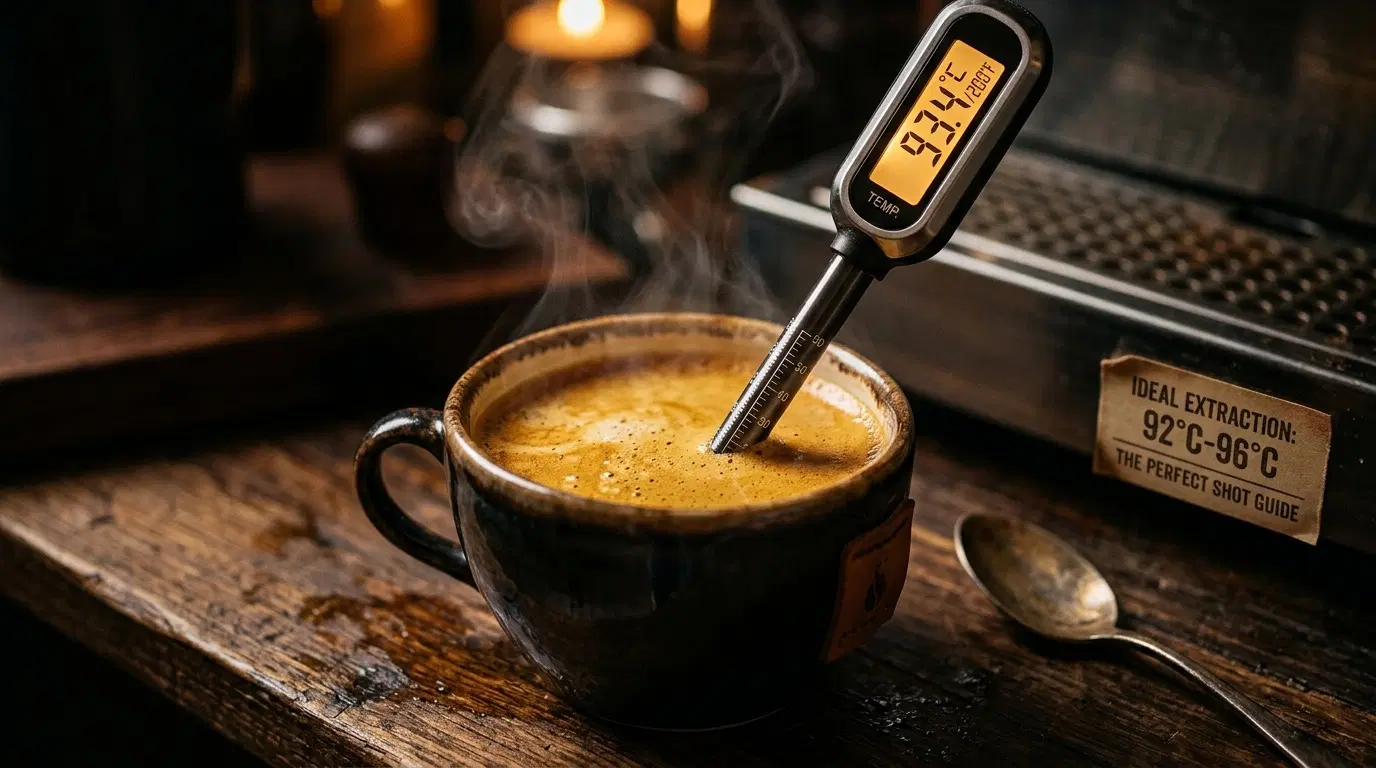
Ideal Coffee Temperature: Extraction & Serving Guide 2026
What temperature extracts and serves the best coffee? Master espresso, pour-over, and cold brew temps with this expert guide.
Ideal Coffee Temperature: Extraction & Serving Guide 2026
Temperature is the most overlooked variable in home coffee brewing. Yet a few degrees can turn an exceptional coffee into a disappointing cup. This guide explains everything you need to know about ideal coffee temperature, from extraction to the moment you take your first sip.
Quick answer: Extract espresso at 197-201°F (92-94°C). Drink it at 140-158°F (60-70°C). Light roasts need slightly hotter water; dark roasts need slightly cooler water. Cold brew extracts at room temp or in the fridge over 12-24 hours.
Temperature: The #1 Extraction Variable
Hot water is the solvent that extracts aromatic compounds, acids, sugars, and caffeine from coffee grounds. But not all compounds dissolve at the same temperature:
| Temperature | Compounds extracted | Result |
|---|---|---|
| < 185°F (< 85°C) | Acids only | Under-extracted, sour, weak body |
| 185-194°F (85-90°C) | Acids + some aromatics | Light, floral, unbalanced |
| 194-201°F (90-94°C) | Balanced acids/sugars/aromas | Sweet spot — balanced cup |
| 201-205°F (94-96°C) | More bitterness and body | Powerful, robust flavor |
| > 205°F (> 96°C) | Excess bitterness | Over-extracted, harsh, astringent |
Recommended Temperatures by Brewing Method
Espresso
Ideal range: 194-203°F (90-95°C)
The SCA recommends 197-201°F (92-94°C) as the optimal range for most espresso coffees. This is where fruity acids, sweet notes, and body reveal themselves in balance.
Practical rule:
- Light roast: 201-203°F (94-95°C) — fruity acids need more energy to extract
- Medium roast: 197-201°F (92-94°C) — standard zone
- Dark roast: 194-197°F (90-92°C) — avoid over-extracting existing bitterness
Drip Coffee (V60, Chemex, French Press)
Ideal range: 195-205°F (91-96°C)
For drip methods, the window is slightly higher because extraction is shorter and more dynamic. The classic barista rule—boil water and wait 30 seconds—usually yields 199-203°F (93-95°C), which is perfect.
| Method | Temperature | Brew time |
|---|---|---|
| V60 | 199-203°F (93-95°C) | 2:30-3:00 min |
| Chemex | 201-205°F (94-96°C) | 3:30-4:00 min |
| French press | 199-203°F (93-95°C) | 4 minutes |
| Moka pot (Bialetti) | 185-194°F (85-90°C) | 5-7 minutes |
| AeroPress | 176-203°F (80-95°C) | 1-3 minutes |
Moka Pot (Stovetop Espresso)
Ideal range: 185-194°F (85-90°C)
The Bialetti works differently: steam pressure forces water through the coffee. Extraction temperature is naturally lower (~185°F / 85°C), which produces a concentrated but less bitter cup than an over-extracted espresso.
Tip: Always fill the bottom chamber with preheated water to reduce time on the burner and avoid burnt flavors.
Cold Brew
Ideal range: 39-72°F (4-22°C)
Cold extraction is a method all its own. At low temperatures, only the most soluble compounds extract—natural sugars and some fruity aromatics—while chlorogenic acids and bitter compounds stay largely in the grounds.
Result: a naturally sweet, very low-bitterness coffee with roughly 30% less acidity than hot-brewed filter coffee.
Serving Temperature: When to Drink Your Coffee
Extracting at the right temperature is only half the battle—you also need to drink at the right temperature.
The Ideal Drinking Zone
140-158°F (60-70°C): Ideal zone for espresso or drip coffee.
At this temperature:
- Volatile aromatic compounds are active and travel to your nose
- Acidity is perceived as brightness, not sharpness
- Bitterness is balanced by natural sugars
- Body and mouthfeel are fully perceptible
Why avoid scalding hot coffee (> 167°F / 75°C)?
Above 167°F (75°C), your taste buds are partially numbed by heat. You perceive fewer flavor nuances and more burning sensation. Studies also show that regularly drinking very hot beverages increases esophageal cancer risk.
Why avoid lukewarm coffee (< 122°F / 50°C)?
Below 122°F (50°C), volatile aromas condense and become harder to detect. The cup tastes flat, sour, and bitter because sweetness seems to disappear. This is why coffee left on a warming plate degrades so quickly.
Serving Temperature Reference
| Temperature | Perception | Recommendation |
|---|---|---|
| > 176°F (> 80°C) | Scalding, aromas masked | Wait |
| 158-176°F (70-80°C) | Very hot, drinkable | For fans of very hot coffee |
| 140-158°F (60-70°C) | Ideal — all aromas active | Recommended zone |
| 122-140°F (50-60°C) | Warm, slight aroma loss | Acceptable |
| < 122°F (< 50°C) | Cool, flat and sour | Avoid (unless intentional cold brew) |
How Automatic Machines Handle Temperature
Modern bean-to-cup machines manage temperature automatically. Here is how the leading brands approach it:
De'Longhi (Magnifica Evo, Magnifica Start)
The De'Longhi Magnifica Evo extracts at 197-201°F (92-94°C) by default, right in the sweet spot. Its aluminum thermoblock heats quickly and maintains reasonable stability.
👉 🛒 De'Longhi Magnifica Evo on Amazon
Philips (3200, 2200)
The Philips 3200 LatteGo also extracts in the 196-199°F (91-93°C) range. Its thermoblock recovers heat well between consecutive cups.
👉 🛒 Philips 3200 LatteGo on Amazon
Jura (E8, E6)
Jura is known for thermal stability thanks to P.E.P. (Pulse Extraction Process). Temperature varies by only ±0.9°F (±0.5°C) during extraction—exceptional precision for a consumer machine.
How to Measure and Control Temperature
Infrared Thermometer
👉 🛒 Etekcity Infrared Thermometer — ~$15
Great for quickly checking the temperature of your cup or the coffee stream. It measures surface temperature only.
Probe Thermometer
👉 🛒 Stainless Steel Probe Thermometer — ~$22
More accurate for measuring water inside a kettle or carafe. Ideal for manual pour-over brewing.
For Automatic Machines
If your machine does not let you adjust temperature, you can sometimes influence it indirectly:
- Preheat your cup: Pour hot water into the cup before extraction to prevent thermal shock
- Adjust strength: Some machines change brewing temperature slightly when you select a stronger cup
- Check hidden settings: Some models have undocumented temperature adjustments available through button combinations (check user forums)
Altitude and Brewing Temperature
An often-overlooked detail: water boils at a lower temperature at higher altitudes. If you live in the mountains (> 3,300 ft / 1,000m), your water boils at roughly 207°F (97°C) instead of 212°F (100°C), which directly affects machines that heat to boiling.
| Altitude | Boiling point | Impact |
|---|---|---|
| Sea level | 212°F (100°C) | Standard |
| 1,640 ft (500m) | 209°F (98.5°C) | Negligible |
| 3,300 ft (1,000m) | 207°F (97°C) | Minimal |
| 6,500 ft (2,000m) | 199°F (93°C) | Notable—adjust grind finer |
Above 5,000 ft (1,500m), consider using a slightly finer grind to compensate for the lower extraction temperature.
FAQ
What temperature should I extract espresso at?
The SCA recommends 195-205°F (90-96°C). Most roasters suggest 197-201°F (92-94°C) for a balanced shot. Below 194°F (90°C) it will be sour; above 205°F (96°C) it will be bitter.
What temperature should I drink coffee at?
The ideal drinking temperature for espresso is 140-158°F (60-70°C). At this range all aromas are volatile and perceptible. Below 131°F (55°C) some aromas fade. Below 104°F (40°C) it tastes sour and flat.
Does my machine heat water to the right temperature?
Most modern automatic machines (De'Longhi, Philips, Jura) are calibrated from the factory to extract between 194°F and 203°F (90-95°C). If in doubt, verify with a contact thermometer or check if your model displays temperature.
Why is my coffee bitter even with a good machine?
Excessive bitterness usually stems from over-extraction: water too hot (> 205°F / 96°C), grind too fine, or extraction time too long. Try lowering the temperature if adjustable, or coarsening the grind.
Does cold brew need a specific temperature?
Cold brew extracts at room temperature (64-72°F / 18-22°C) or in the refrigerator (39°F / 4°C) over 12-24 hours. This cold method yields a sweeter, less acidic, and very low-bitterness coffee because acids and bitter compounds do not dissolve well in cold water.
How does altitude affect brewing?
At higher elevations water boils at a lower temperature, reducing your maximum extraction temperature. Above 6,500 ft (2,000m), use a slightly finer grind to maintain proper extraction.
Conclusion
Temperature is the invisible hand that shapes every cup of coffee. Extract too cool and your coffee tastes sour and thin. Extract too hot and it turns bitter and harsh. Serve too hot and you miss the aromas. Serve too cool and the cup falls flat.
The rule is simple: extract at 197-201°F (92-94°C) for espresso, drink at 140-158°F (60-70°C), and adjust slightly by roast level. Master temperature, and you have mastered one of the most important levers in coffee quality.
→ Read next: How to make perfect espresso at home → Best automatic coffee machines 2026 → Best filter coffee machines 2026
📧 Never miss a coffee deal
Sign up to get our expert reviews and promo alerts straight to your inbox.
🔒 Join 5,000+ readers — By signing up, you agree to our privacy policy.
Articles similaires

Espresso vs Capsule vs Filter: Which Method for You? (2026)
Espresso, capsule, or filter? We compare the three most popular coffee brewing methods on taste, cost, convenience, and equipment requirements.
Lire l'article →
Best Coffee Machine for Your Office: 2026 Buying Guide
Find the best coffee machine for your office by team size, noise level, and budget. Capsule, bean-to-cup, and drip options covered.
Lire l'article →
Coffee Grind Settings Guide 2026: Perfect Extraction
Master coffee grind size for every brewing method. Espresso, pour-over, French press, cold brew—find the exact settings and troubleshooting tips here.
Lire l'article →