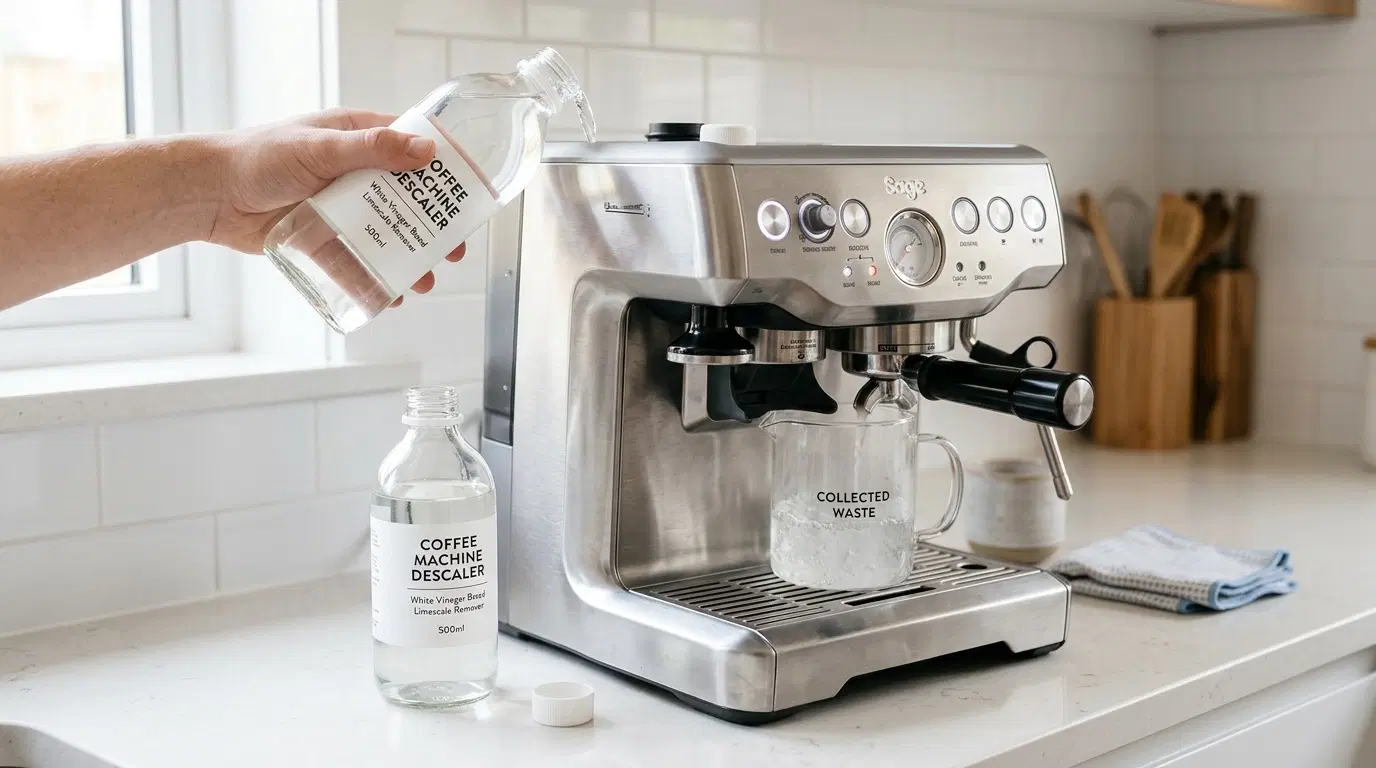
How to Descale Your Coffee Machine in 2026: Step Guide
Learn how to descale your espresso or bean-to-cup machine step by step. Best products, frequency by water hardness, and brand-specific instructions included.
How to Descale Your Coffee Machine in 2026: Step-by-Step Guide
Limescale is the silent enemy of coffee machines. It builds up in water circuits week after week, slowly reducing pressure, dropping extraction temperature, wearing out the pump, and—eventually—killing the machine. The good news: regular descaling costs less than $20 and takes about 30 minutes. Here is everything you need to know to do it right.
Quick answer: Descale your coffee machine every 2 to 3 months with a dedicated descaler (Durgol or EcoDecalk) to extend its life to 10–15 years. Never use vinegar on espresso machines—it attacks seals and leaves a persistent odor.
Why Descaling Matters
Tap water contains minerals, mainly calcium and magnesium. When water heats inside your machine, these minerals precipitate and form limescale—that white crust you have probably seen in your kettle.
In a coffee machine, limescale accumulates in:
- The boiler (or thermoblock): water heats less efficiently, extraction temperature drops
- Internal pipes: water flow slows, pressure decreases
- The pump: it strains to push water through scale buildup, wearing out prematurely
The impact on your coffee is immediate:
- Cooler coffee: water no longer reaches the ideal 88–93°C extraction range
- Watery espresso: insufficient pressure produces under-extracted, sour coffee with no crema
- Mineral aftertaste: limescale releases an unpleasant flavor
- Abnormal noise: the pump grinds, whistles, or labors
Ignoring descaling does not just hurt taste—it jeopardizes your machine's lifespan. An undescaled machine lasts 3 to 5 years. A descaled one can last 10 to 15 years.
How Often Should You Descale?
Frequency depends on water hardness (measured in grains per gallon, gpg) and usage intensity.
| Water hardness | gpg | Recommended frequency |
|---|---|---|
| Soft | < 8.5 gpg | Every 4 to 6 months |
| Moderate | 8.5–15 gpg | Every 2 to 3 months |
| Hard | 15–25 gpg | Every 1 to 2 months |
| Very hard | > 25 gpg | Every month (+ water filter recommended) |
To find your water hardness, use a water hardness test kit (~$5) or check your local water utility's website (often searchable by ZIP code).
Your machine's descaling indicator takes priority. If your De'Longhi, Philips, or Jura displays a descaling alert, do not ignore it—it calculates hardness programmed at setup and total liters used. Trust it over the calendar.
What Products to Use?
Durgol Express — The Universal Professional Standard
Durgol Express is the reference descaler in Europe and increasingly available in the US. Its sulfamic acid dissolves limescale quickly without attacking seals or metal. It is compatible with all brands and certified by several manufacturers (Jura, Miele, Nespresso).
One 4.2 fl oz bottle treats one standard machine. Effective in 15 to 20 minutes, with no unpleasant odor.
👉 🛒 Check price on Amazon → (~$15)
De'Longhi EcoDecalk — The De'Longhi Standard
EcoDecalk is De'Longhi's official descaler, designed specifically for their machines (Magnifica, Dinamica, Eletta). It uses natural-origin lactic acid—less aggressive on internal seals than some mineral acids.
If you own a De'Longhi, this is the product your machine was engineered to receive. It is also compatible with other brands.
👉 🛒 Check price on Amazon → (~$12)
White Vinegar — The Natural Alternative (With Caveats)
White vinegar is the household descaler many use for drip coffee makers. It works on simple models with direct heating elements.
However, for automatic espresso machines, it is strongly discouraged:
- It attacks silicone seals over time
- Its odor permeates internal circuits and lingers
- All espresso machine manufacturers explicitly exclude it from warranty coverage
Reserve white vinegar for your drip coffee maker or kettle. For your espresso machine, invest in the right product.
Step-by-Step Descaling Guide
General Procedure (Most Machines)
- Empty the water tank and remove the water filter if your machine has one
- Prepare the descaling solution: dilute the product in water per manufacturer instructions (typically one bottle per 1 liter of water)
- Fill the tank with the prepared solution
- Place a container under the spout (a bowl or carafe holding at least 1 liter)
- Start the descaling program from your machine's menu—most modern machines have one accessible from the interface
- Let the cycle run: the machine circulates the solution in multiple cycles (15 to 30 minutes)
- Rinse twice with clean water by running a water-only cycle
- Reinstall the water filter (if applicable) and refill the tank
By Brand
De'Longhi (Magnifica, Dinamica, Eletta) The descaling program is accessible via the on-screen menu. The machine guides you step by step, indicating when to add solution and when to rinse. Total time: 20 to 30 minutes.
Philips (2200, 3200, 5400 series) Press and hold the coffee and steam buttons simultaneously for 3 seconds to enter maintenance mode. The screen displays the steps to follow. Use Philips EcoDecalk or a compatible equivalent.
Krups (EA87xx, EA81xx) Turn the dial to the "calc clean" position (represented by a snowflake). Follow the indicator lights. The procedure takes about 25 minutes with two automatic rinses.
Jura Jura exclusively recommends its own descaling tablets (Jura Descaling Tablets). Drop a tablet into the water-filled tank and start the program from the menu. The machine fully automates the process.
How to Reduce Limescale and Space Out Descaling
Use the Built-In Water Filter
Most premium machines (De'Longhi, Philips, Jura) include a slot for a water filter (Claris, Brita Intenza, or equivalent). This filter reduces water hardness at the source, significantly slowing limescale buildup.
Replace the filter every 2 to 3 months or every 50 liters—a modest cost ($5 to $10 per filter) that can halve your descaling frequency.
Use Filtered or Soft Mineral Water
If your water is particularly hard, using a pitcher filter (Brita, ZeroWater) to fill your machine's tank can dramatically reduce scale. Some users mix half tap water and half soft mineral water—an effective compromise.
Set the Correct Hardness in Settings
Most modern machines let you program your water hardness in the settings. This value is used to calculate descaling alert frequency. If your water is soft, set this correctly to avoid unnecessary descaling cycles.
Empty the Tank During Periods of Non-Use
Stagnant water in the tank encourages mineral deposits. If you go on vacation or do not use your machine for more than a week, empty the reservoir.
Conclusion
Descaling is the most important maintenance task for your coffee machine—and one of the simplest. Twenty minutes every two to three months is enough to keep your machine running perfectly, protect your espresso from off-flavors, and extend your appliance's life by a decade.
Invest in a quality descaler suited to your machine:
👉 🛒 Durgol Express (universal) — ~$15 👉 🛒 De'Longhi EcoDecalk (for De'Longhi machines) — ~$12
It is the best preventive investment you can make for your machine.
Summary
Descale every 2 to 3 months with Durgol Express or EcoDecalk to preserve extraction temperature, pressure, and machine lifespan. Never use vinegar on espresso machines. Use a water filter and set hardness in your machine's settings to reduce descaling frequency.
→ Read next: Coffee machine maintenance guide → Best automatic espresso machines 2026 → Best bean-to-cup coffee machines 2026
📧 Never miss a coffee deal
Sign up to get our expert reviews and promo alerts straight to your inbox.
🔒 Join 5,000+ readers — By signing up, you agree to our privacy policy.
Articles similaires

Espresso vs Capsule vs Filter: Which Method for You? (2026)
Espresso, capsule, or filter? We compare the three most popular coffee brewing methods on taste, cost, convenience, and equipment requirements.
Lire l'article →
Best Coffee Machine for Your Office: 2026 Buying Guide
Find the best coffee machine for your office by team size, noise level, and budget. Capsule, bean-to-cup, and drip options covered.
Lire l'article →
Coffee Grind Settings Guide 2026: Perfect Extraction
Master coffee grind size for every brewing method. Espresso, pour-over, French press, cold brew—find the exact settings and troubleshooting tips here.
Lire l'article →