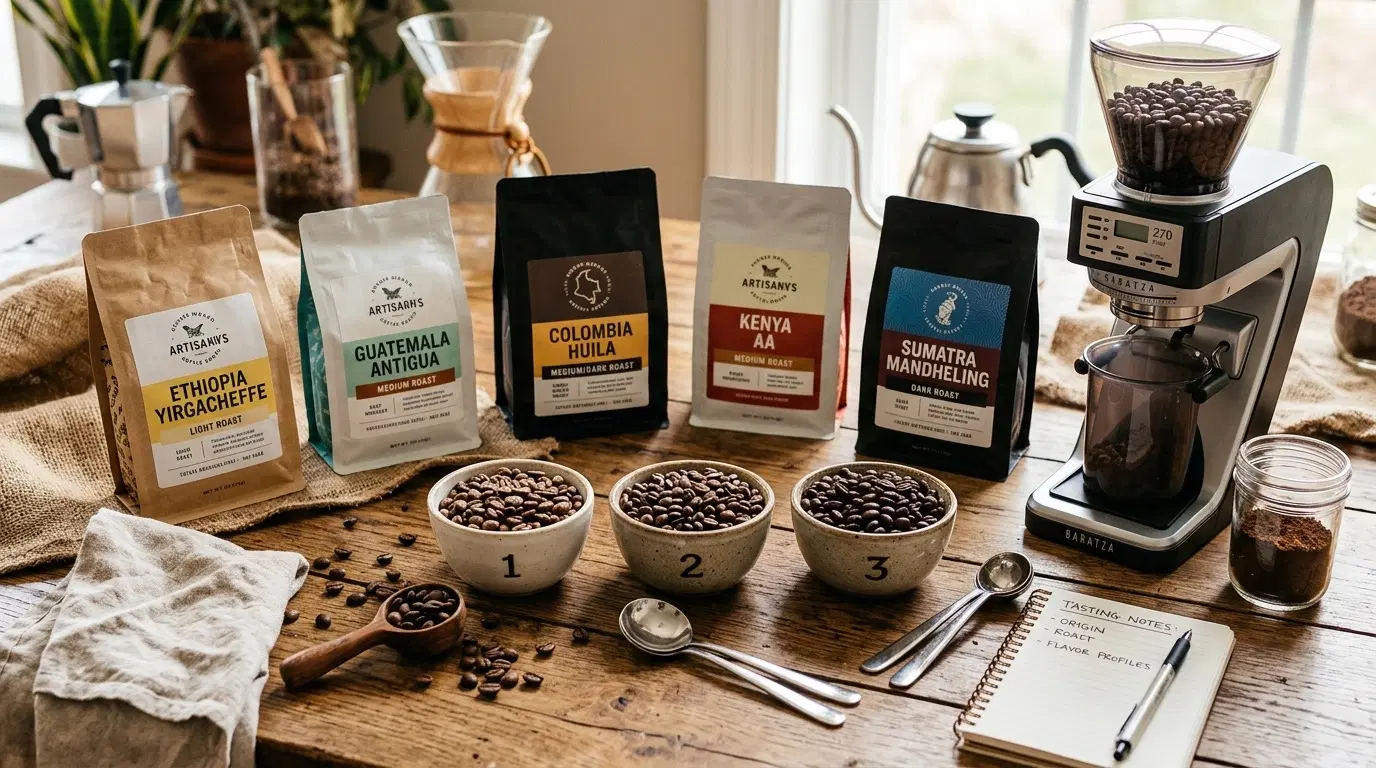
How to Choose Coffee Beans 2026: Beginner's Guide (5 Tips)
5 expert tips for choosing coffee beans in 2026. Single origin vs blend, roast levels, processing methods. Avoid the 3 most common mistakes →
Affiliate links: we earn a commission on purchases, at no extra cost to you.
In brief
Who it's for
Coffee drinkers who want to pick the right beans for their taste and their brewing method
Budgets
Everyday blends · $5-11/250g
Specialty · $11-22/250g
Rare micro-lots · $22+/250g
Quick answer
Arabica or robusta, which to choose?
For most coffee lovers, arabica is the best choice: more aromatic, smoother, less bitter. Robusta is interesting in blends (10-20%) to add body and crema to espresso. Avoid 100% robusta except for Turkish or Vietnamese coffee.
Key facts
5 buying criteria · 5 detailed comparisons
How to Choose Coffee Beans: A Complete Guide
Standing in the coffee aisle or browsing a roaster's website can be overwhelming. Arabica, robusta, single origin, blend, light or dark roast, altitude, washed process... The terms pile up and the choice seems impossible. This guide decodes everything.
The Two Species: Arabica vs Robusta
The coffee world rests on two main species:
Arabica (60-70% of world production)
- Taste: Smooth, aromatic, complex. Notes of fruit, flowers, chocolate
- Acidity: Present and pleasant (like in wine)
- Caffeine: 1.2% (moderate)
- Cultivation: Altitude 600-2000m, tropical climate
- Price: More expensive (difficult cultivation)
Robusta (30-40% of world production)
- Taste: Bold, bitter, earthy. Notes of wood, dark cocoa
- Acidity: Low
- Caffeine: 2.7% (2x more than arabica)
- Cultivation: Low altitude, disease-resistant
- Price: Less expensive
Our advice: Start with 100% arabica. Once you know your preferences, you can explore arabica/robusta blends (80/20 is a classic ratio for Italian espresso).
Roast Level: The Decisive Factor
Roasting transforms the green bean into a brown bean ready to be ground. The roast level dramatically changes the taste.
Light Roast
- Colour: Cinnamon brown
- Taste: Bright acidity, fruity and floral notes
- Body: Light
- Ideal for: Gentle brewing methods (V60, Chemex, AeroPress)
- Not ideal for: Espresso (too acidic for most palates)
Medium Roast
- Colour: Chocolate brown
- Taste: Balanced, notes of caramel, hazelnut, chocolate
- Body: Medium
- Ideal for: Everything! Espresso, filter, Italian moka pot
- This is: The safest choice for beginners
Dark Roast
- Colour: Dark brown to black, oily surface
- Taste: Bitter, smoky, notes of dark cocoa and toast
- Body: Heavy
- Ideal for: Traditional Italian espresso, café au lait
- Note: Origin aromas are masked by the roast
Common mistake: Associating "dark roast" with "strong coffee." A coffee's strength depends on the dose, not the roast. A light roast with the right dose can be just as intense as a dark one.
Origin: Each Country Has Its Profile
| Origin | Flavour Profile | Ideal For |
|---|---|---|
| Ethiopia | Fruity, floral, tea-like | Filter, V60 |
| Colombia | Smooth, caramel, nuts | Espresso, versatile |
| Brazil | Chocolate, hazelnut, smooth | Espresso, blend base |
| Kenya | Bright acidity, blackcurrant, citrus | Filter |
| Guatemala | Chocolate, spices, full body | Espresso |
| Costa Rica | Honey, apple, clean | Filter, espresso |
| Indonesia (Sumatra) | Earthy, spicy, heavy body | Dark espresso |
| Vietnam | Robusta, strong, bitter chocolate | Vietnamese coffee |
Single Origin vs Blend
- Single Origin: Coffee from a single region/farm. Unique and traceable flavour profile. More expensive, more interesting for discovery.
- Blend: A mix of several origins. Designed for balance and consistency. Ideal for everyday espresso.
Freshness: The Underestimated Criterion
Freshness is the factor that makes the biggest difference and that 90% of consumers ignore.
Freshness Timeline
| Time After Roasting | State |
|---|---|
| 0-3 days | Degassing (CO2), coffee too fresh for espresso |
| 7-14 days | Peak aroma — best moment |
| 14-30 days | Excellent |
| 1-2 months | Good, declining aromas |
| 2-4 months | Mediocre |
| 6+ months | Stale, flat |
The supermarket problem: Most supermarket coffees were roasted 3-12 months ago. The date on the packet is often a "best before" date, not a roast date.
The solution: Buy from a roaster who displays the roast date. Ordering online from roasters guarantees optimal freshness.
How to Read a Coffee Label
Here's what to look for on a quality coffee packet:
- Roast date (not the best-before date) → less than 4 weeks
- Species: 100% arabica or blend
- Origin: Country, region, or even farm
- Altitude: Higher = more complex (>1200m is a good sign)
- Process: Washed (clean), natural (fruity), honey (sweet)
- Roast level: Light, medium, dark
- Tasting notes: Chocolate, red berries, hazelnut...
Red flags:
- No roast date → probably old
- "Arabica/robusta blend" without percentages → often lots of robusta
- Price < $11/kg → questionable quality
Our Recommendations by Use
For Everyday Espresso
A medium to medium-dark blend, Brazil/Colombia base. Notes of chocolate and hazelnut. 🛒 → See espresso coffee beans on Amazon
For Discovery
Single origins in medium roast. Ethiopia Yirgacheffe or Kenya AA for pronounced flavour profiles. 🛒 → See single origin coffees on Amazon
For the Italian Moka Pot
A medium-dark blend, appropriate grind. Notes of chocolate, caramel, slightly bold. 🛒 → See moka pot coffee beans on Amazon
Storage: The Golden Rules
- Opaque airtight container (not the original bag once opened)
- Room temperature (never in the fridge or freezer)
- Away from light and heat
- Buy in small quantities: max 2 weeks' worth of consumption
- Grind only when you prepare your coffee
🛒 → See coffee storage containers on Amazon
Conclusion
Choosing coffee beans is like choosing wine: there is no absolute "best," only what matches your taste. Start with a medium roast 100% arabica blend, experiment with single origins, and note what you like. The journey is as enjoyable as the destination — cup after cup.
📧 Never miss a coffee deal
Sign up to get our expert reviews and promo alerts straight to your inbox.
🔒 Join 5,000+ readers — By signing up, you agree to our privacy policy.
Related guides
Articles similaires
Christmas Coffee Gift Guide 2026: Best Ideas to Give
Christmas 2026 coffee gifts: the best capsule machine sets, bean-to-cup machines, premium coffee beans and barista accessories. Selection by budget, with the lowdown on Black Friday deals.
Lire l'article →
2026 Study: The Real Cost of a Cup of Coffee at Home
What does a cup of coffee at home really cost in 2026? Study based on real prices: automatic bean 0,28 €, capsules 0,55 €, filter 0,47 €, moka 0,36 €. Bean machine vs capsules break-even: 17 months.
Lire l'article →
Best Coffee Beans 2026: Tested in Real Conditions
Best coffee beans 2026: Lavazza, illy, Nespresso Original and compatible capsules put to the test. Selection by use, budget and machine — the guide to choosing a coffee that changes your daily routine.
Lire l'article →