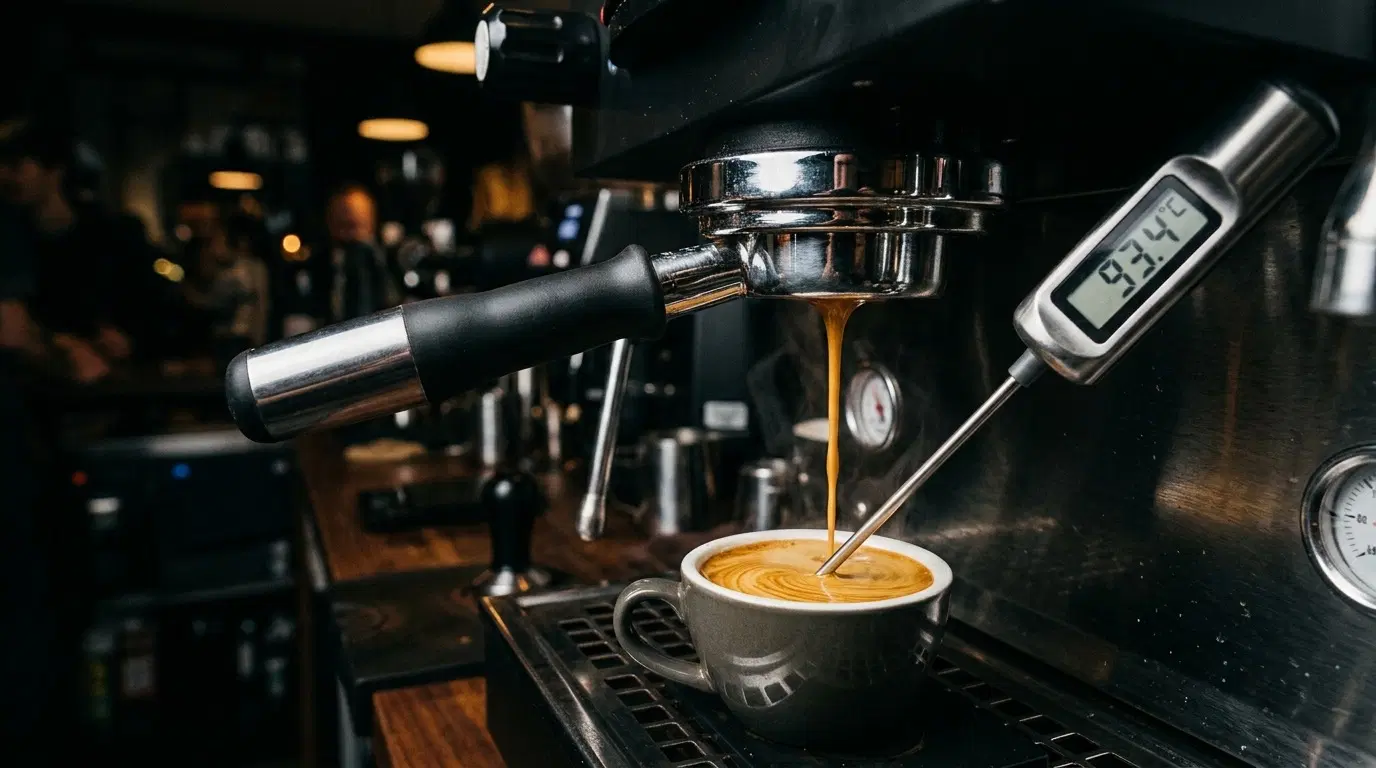
Temperature and Extraction: The Secrets of Perfect Coffee
Complete guide on coffee temperature and extraction: key variables, under-extraction vs over-extraction, ratios, timing. Master the science behind your cup.
Temperature and Extraction: The Secrets of Perfect Coffee
Behind every cup of coffee lies chemistry. Extraction — the process by which water dissolves the soluble compounds from ground coffee — is the key that separates exceptional coffee from mediocre coffee. Understanding the variables gives you the power to correct and optimize every cup.
What Is Extraction?
Roasted coffee contains approximately 30% soluble compounds. Hot water extracts a portion of them. The goal: extract 18-22% of these compounds (the sweet spot identified by the Specialty Coffee Association).
| Extraction Rate | Result | Taste |
|---|---|---|
| < 18% | Under-extraction | Acidic, sour, watery, salty |
| 18-22% | Optimal extraction | Balanced, sweet, complex |
| > 22% | Over-extraction | Bitter, astringent, dry, burnt |
Compounds dissolve in a specific order:
- Acids (extracted first) — acidity, fruitiness
- Sugars (mid-extraction) — sweetness, caramel
- Bitterness (extracted last) — dark chocolate, then astringence
A good coffee captures the acids AND sugars while limiting excessive bitterness.
☕ Decaf has its secrets too. The decaffeination process alters the bean structure and requires temperature adjustment. Discover our decaf coffee guide.
Variable 1: Water Temperature 🌡️
Temperature is the most impactful variable and the easiest to control.
The Optimal Range: 90-96°C
| Temperature | Effect |
|---|---|
| < 85°C | Severe under-extraction. Bland and acidic coffee. |
| 85-89°C | Slight under-extraction. Acceptable for dark roasts. |
| 90-93°C | Lower ideal zone. Sweetness, less bitterness. Ideal for dark roast. |
| 93-96°C | Upper ideal zone. Complete extraction. Ideal for light/medium roast. |
| > 96°C | Over-extraction. Bitterness, astringence, burnt taste. |
| 100°C | Boiling water. NEVER pour boiling water over coffee. |
Practical Rule
- Dark roast → Low temperature (90-92°C) — Compensates for natural bitterness
- Medium roast → Medium temperature (92-94°C)
- Light roast → High temperature (94-96°C) — Helps extract sugars
Tip without a thermometer: Boil the water, then wait 30-60 seconds. You'll be in the 90-96°C range.
❄️ Complete cold brew guide. Cold extraction doesn't require a thermometer. Ratios, timing, and coffee selection in our homemade cold brew guide.
Variable 2: The Grind 🔧
Grind size determines the contact surface between water and coffee. The finer the grind, the faster and more intense the extraction.
| Method | Grind | Reference Size |
|---|---|---|
| Turkish coffee | Ultra-fine | Powder, like talc |
| Espresso | Fine | Table salt |
| Moka (Italian) | Medium-fine | Powdered sugar |
| Filter / V60 | Medium | Sand |
| French Press | Coarse | Kosher salt |
| Cold brew | Very coarse | Cracked pepper |
The rule: If your coffee is too bitter → coarser grind. If your coffee is too acidic → finer grind.
Variable 3: Coffee-to-Water Ratio ⚖️
The ratio (coffee dose vs water amount) is the second pillar of extraction.
Standard Ratios
| Method | Ratio | Example |
|---|---|---|
| Espresso | 1:2 | 18g coffee → 36g in cup |
| Ristretto | 1:1.5 | 18g coffee → 27g in cup |
| Lungo | 1:3 | 18g coffee → 54g in cup |
| Filter/V60 | 1:15 to 1:17 | 15g coffee → 250ml water |
| French Press | 1:15 | 30g coffee → 450ml water |
| Italian coffee maker | Fill the basket | Dose fixed by the model |
| Cold brew | 1:8 | 100g coffee → 800ml water |
The principle: The more water you use per gram of coffee, the more the extraction is pushed. A 1:18 ratio extracts more than a 1:15.
Invest in a Scale
A precision scale (0.1g) is the most transformative tool for improving your coffee. It costs €15 and lets you reproduce exactly the same cup every day.
🛒 → View coffee scales on Amazon
Variable 4: Contact Time ⏱️
The time water is in contact with coffee directly influences the extraction rate.
| Method | Optimal Time |
|---|---|
| Espresso | 25-35 seconds |
| AeroPress | 1-2 minutes |
| V60 | 2:30-3:30 minutes |
| Italian coffee maker | 4-5 minutes (medium heat) |
| French Press | 4 minutes |
| Chemex | 3:30-4:30 minutes |
| Cold brew | 12-24 hours |
Time too short = under-extraction (acidic). Time too long = over-extraction (bitter).
In espresso, time is controlled by the grind: finer grind = water passes more slowly = longer time.
Variable 5: Water Quality 💧
Water makes up 98% of your cup of coffee. Its chemical composition directly influences the taste.
What You Need to Know
- Ideal TDS (Total Dissolved Solids): 75-150 ppm
- Ideal pH: 6.5-7.5 (neutral)
- Calcium: Necessary for extraction, but causes limescale
- Chlorine: Kills aromas. Use filtered water.
Water too soft (< 50 ppm): Under-extraction, flat coffee Water too hard (> 200 ppm): Over-extraction, chalky coffee + limescale
Simple solution: A filter pitcher (Brita) is sufficient for most situations.
The Diagnostic Guide
Your coffee isn't good? Here's how to fix it:
Coffee Too Acidic / Sour
→ Under-extraction. Solutions:
- Finer grind
- Higher temperature
- Longer contact time
- More water (higher ratio)
Coffee Too Bitter / Astringent
→ Over-extraction. Solutions:
- Coarser grind
- Lower temperature
- Shorter contact time
- Less water (lower ratio)
Coffee Bland / Watery
→ Under-dosed or under-extracted. Solutions:
- Increase the coffee dose
- Finer grind
- Check coffee freshness (> 2 months = bland)
Coffee Perfect But Inconsistent
→ Lack of precision. Solutions:
- Use a scale (dose to the gram)
- Time the extraction
- Control the temperature
- Use the same water
The Perfect Espresso: The Baseline Recipe
For those who want a reliable starting recipe:
| Parameter | Value |
|---|---|
| Dose | 18g |
| Yield | 36g in cup |
| Ratio | 1:2 |
| Time | 25-30 seconds |
| Temperature | 93°C |
| Grind | Fine (adjust if out of time range) |
Start with this recipe and adjust one variable at a time:
- Too acidic → finer grind OR temperature +1°C
- Too bitter → coarser grind OR temperature -1°C
- Too weak → increase dose (19g)
- Too intense → decrease dose (17g)
Conclusion
Coffee extraction is an accessible science. Temperature, grind, ratio, time, and water quality: these five variables are the levers that transform ordinary coffee into a sensory experience. No need for €2,000 equipment — a variable temperature kettle, a scale, and a good grinder are enough to achieve excellence.
The best advice: change only one variable at a time. Taste, adjust, repeat. Within a few days, you'll produce coffee better than 90% of what's served in restaurants.
📧 Never miss a coffee deal
Sign up to get our expert reviews and promo alerts straight to your inbox.
🔒 Join 5,000+ readers — By signing up, you agree to our privacy policy.
Articles similaires

Christmas Coffee Gift Guide 2026: Best Ideas to Give
Christmas 2026 coffee gifts: the best capsule machine sets, bean-to-cup machines, premium coffee beans and barista accessories. Selection by budget, with the lowdown on Black Friday deals.
Lire l'article →
2026 Study: The Real Cost of a Cup of Coffee at Home
What does a cup of coffee at home really cost in 2026? Study based on real prices: automatic bean 0,28 €, capsules 0,55 €, filter 0,47 €, moka 0,36 €. Bean machine vs capsules break-even: 17 months.
Lire l'article →
Best Coffee Beans 2026: Tested in Real Conditions
Best coffee beans 2026: Lavazza, illy, Nespresso Original and compatible capsules put to the test. Selection by use, budget and machine — the guide to choosing a coffee that changes your daily routine.
Lire l'article →