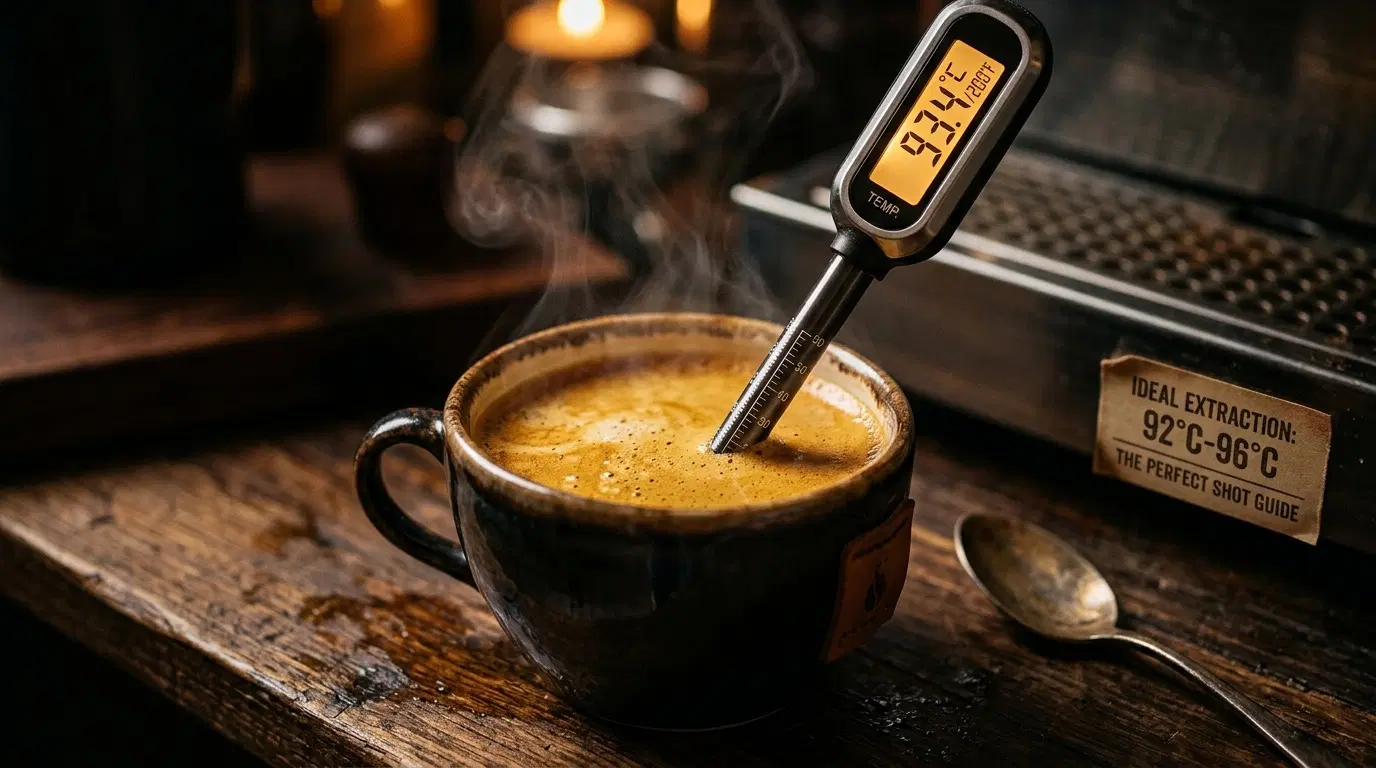
Ideal Coffee Temperature: Extraction & Tasting Guide 2026
What's the ideal temperature for extracting and tasting the perfect coffee? Complete guide on espresso and filter extraction temperatures, plus serving temperatures to reveal all aromas.
Ideal Coffee Temperature: Extraction & Tasting Guide 2026
Temperature is the most overlooked variable among coffee enthusiasts. Yet, a few degrees of difference can transform an exceptional coffee into a disappointing cup. This guide explains everything you need to know about the ideal coffee temperature, from extraction to tasting.
Temperature: The #1 Extraction Variable
Hot water is the solvent that extracts aromatic compounds, acids, sugars, and bitter compounds from coffee beans. But all these compounds don't dissolve at the same temperature:
| Temperature | Compounds Extracted | Result |
|---|---|---|
| < 85°C | Acids only | Under-extracted coffee, acidic, thin-bodied |
| 85-90°C | Acids + some aromas | Light coffee, floral, unbalanced |
| 90-94°C | Balance of acids/sugars/aromas | Ideal zone — balanced coffee |
| 94-96°C | More bitters and body | Powerful coffee, robust |
| > 96°C | Excess bitters | Over-extracted coffee, bitter, harsh |
Recommended Temperatures by Extraction Method
Espresso
Ideal temperature: 90-95°C
The SCA (Specialty Coffee Association) recommends 92-94°C as the optimal range for the vast majority of espresso coffees. This is the temperature at which fruity acids, sweet notes, and body are revealed in balance.
Practical rule:
- Light roast coffee: 94-95°C (fruity acids need more energy)
- Medium roast coffee: 92-94°C (standard zone)
- Dark roast coffee: 90-92°C (avoid over-extracting the bitters already present)
Filter Coffee (V60, Chemex, French Press)
Ideal temperature: 91-96°C
For filter coffee, the window is slightly higher because extraction is shorter and more dynamic. The barista's rule: boil water then wait 30 seconds typically gives 93-95°C — perfect.
| Method | Temperature | Extraction Time |
|---|---|---|
| V60 | 93-95°C | 2:30-3:00 |
| Chemex | 94-96°C | 3:30-4:00 |
| French Press | 93-95°C | 4 minutes |
| Moka (Bialetti) | 85-90°C | 5-7 minutes |
| Aeropress | 80-95°C (variable) | 1-3 minutes |
Moka (Italian Coffee Maker)
Ideal temperature: 85-90°C
The Bialetti and its cousins work differently: it's steam pressure that forces water through the coffee. The extraction temperature is naturally lower (~85°C), producing a more concentrated but less bitter coffee than an over-extracted espresso.
Tip: Always fill the lower chamber with preheated hot water to reduce stovetop time and avoid burnt flavors.
Cold Brew
Ideal temperature: 4-22°C
Cold extraction is a method unto itself. At low temperatures, only the most soluble compounds are extracted — natural sugars and some fruity aromas — while chlorogenic acids and bitter compounds largely remain in the grounds.
Result: a naturally sweet, minimally bitter coffee with 30% less acidity than hot filter coffee.
Serving Temperature: When to Drink Your Coffee
Extracting at the right temperature isn't enough — you also need to drink it at the right temperature.
The Ideal Tasting Zone
60-70°C: Ideal zone for espresso or filter coffee.
At this temperature:
- Volatile aromatic compounds are active and evaporate toward your nose
- Acidity is perceived as freshness, not a sharp bite
- Bitterness is balanced by natural sugars
- Texture (body, smoothness) is fully perceptible
Why avoid scalding coffee (> 75°C)?
Above 75°C, your tongue's taste receptors are partially neutralized by the heat. You perceive fewer aromatic nuances and more of a burning sensation. Studies also show that regularly drinking very hot beverages increases the risk of esophageal cancer.
Why avoid cold coffee (< 50°C)?
Below 50°C, volatile aromas condense and become less perceptible. The coffee seems flat, acidic, and bitter because sugars seem to disappear. This is one reason coffee left on a hot plate rapidly loses quality.
Serving Temperature Table
| Temperature | Perception | Recommendation |
|---|---|---|
| > 80°C | Scalding, aromas masked | Wait |
| 70-80°C | Very hot, acceptable coffee | Drink for those who like very hot coffee |
| 60-70°C | Ideal — all aromas active | Recommended zone |
| 50-60°C | Lukewarm, slight aroma loss | Acceptable |
| < 50°C | Cold, flat and acidic coffee | Avoid (unless intentional cold brew) |
Why Automatic Machines Make Good Coffee
Modern bean-to-cup automatic machines manage temperature automatically. Here's how the main brands handle this parameter:
De'Longhi (Magnifica Evo, Magnifica Start)
The De'Longhi Magnifica Evo extracts at 92-94°C by default, which aligns perfectly with the ideal zone. The aluminum thermoblock heats up quickly and maintains reasonable stability.
🛒 → De'Longhi Magnifica Evo on Amazon
Philips (3200, 2200)
The Philips 3200 LatteGo also extracts in the 91-93°C range. Its thermoblock shows good thermal recovery between coffees.
🛒 → Philips 3200 LatteGo on Amazon
Jura (E8, E6)
Jura is renowned for its thermal stability thanks to P.E.P. (Pulse Extraction Process) technology. Temperature varies by only ±0.5°C during extraction — exceptional precision for a consumer machine.
How to Measure and Control Temperature
Infrared Thermometer
🛒 Etekcity infrared thermometer — ~€15
For measuring the temperature of your cup or coffee output. Practical and fast, but only measures surface temperature.
Probe Thermometer
🛒 Stainless steel probe thermometer — ~€22
More precise for measuring water in a coffee maker or carafe. Ideal for manual filter coffee.
For Automatic Machines
If your machine doesn't allow temperature adjustment, you can sometimes influence it indirectly:
- Preheat the cup: pour hot water into the cup before extraction to avoid thermal shock
- Increase heat: some machines have a "coffee strength" setting that slightly modifies temperature
- Contact customer service: some models have hidden temperature settings documented in forums
The Impact of Altitude on Extraction Temperature
An often overlooked detail: water boils at a lower temperature at altitude. If you live in the mountains (> 1000m altitude), your water boils at 96°C instead of 100°C, which directly affects machines that heat water to boiling point.
| Altitude | Boiling Point | Impact |
|---|---|---|
| 0m (sea level) | 100°C | Standard |
| 500m | 98.5°C | Negligible |
| 1000m | 97°C | Minimal |
| 2000m | 93°C | Notable — adjust the grind |
Above 1500m, consider using a slightly finer grind to compensate for the lower extraction temperature.
FAQ
What temperature should you extract espresso at?
The SCA (Specialty Coffee Association) recommends extraction temperatures between 90 and 96°C. Most roasters advise 92-94°C for a balanced espresso. Below 90°C, the coffee will be under-extracted (acidic); above 96°C, it will be over-extracted (bitter).
What temperature should you drink coffee at?
The ideal tasting temperature for espresso is between 60 and 70°C. At this temperature, all aromas are volatile and perceptible to the nose. Below 55°C, some aromas are lost. Below 40°C, the coffee tastes acidic and flat.
Does my machine heat water to the right temperature?
Most modern automatic machines (De'Longhi, Philips, Jura) are factory-calibrated to extract between 90 and 95°C. If in doubt, some models display the temperature, or you can use a contact thermometer to verify.
Why is my coffee bitter even though I have a good machine?
Excessive bitterness is often due to over-extraction: water too hot (> 96°C), grind too fine, or extraction time too long. Try slightly reducing the temperature if your machine allows it, or coarsening the grind.
Does cold brew require a specific temperature?
Cold brew extracts at room temperature (18-22°C) or in the refrigerator (4°C) for 12-24 hours. This cold extraction is radically different from espresso: it produces a sweeter, less acidic, and very minimally bitter coffee, because acidic and bitter compounds don't dissolve well in cold water.
📧 Never miss a coffee deal
Sign up to get our expert reviews and promo alerts straight to your inbox.
🔒 Join 5,000+ readers — By signing up, you agree to our privacy policy.
Articles similaires
Christmas Coffee Gift Guide 2026: Best Ideas to Give
Christmas 2026 coffee gifts: the best capsule machine sets, bean-to-cup machines, premium coffee beans and barista accessories. Selection by budget, with the lowdown on Black Friday deals.
Lire l'article →
2026 Study: The Real Cost of a Cup of Coffee at Home
What does a cup of coffee at home really cost in 2026? Study based on real prices: automatic bean 0,28 €, capsules 0,55 €, filter 0,47 €, moka 0,36 €. Bean machine vs capsules break-even: 17 months.
Lire l'article →
Best Coffee Beans 2026: Tested in Real Conditions
Best coffee beans 2026: Lavazza, illy, Nespresso Original and compatible capsules put to the test. Selection by use, budget and machine — the guide to choosing a coffee that changes your daily routine.
Lire l'article →