Coffee Temperature & Extraction: Science of Perfect Brew
Master the two most important variables in coffee brewing: water temperature and extraction ratio. This guide explains how to dial in your perfect cup.
Affiliate links: we earn a commission on purchases, at no extra cost to you.
In brief
Who it's for
Home baristas who want to understand how water temperature shapes extraction and flavor in the cup
Budgets
No extra gear · $0-16
Gooseneck kettle · $32-130
Variable-temperature kettle · $130-324
Quick answer
What is the ideal temperature for espresso?
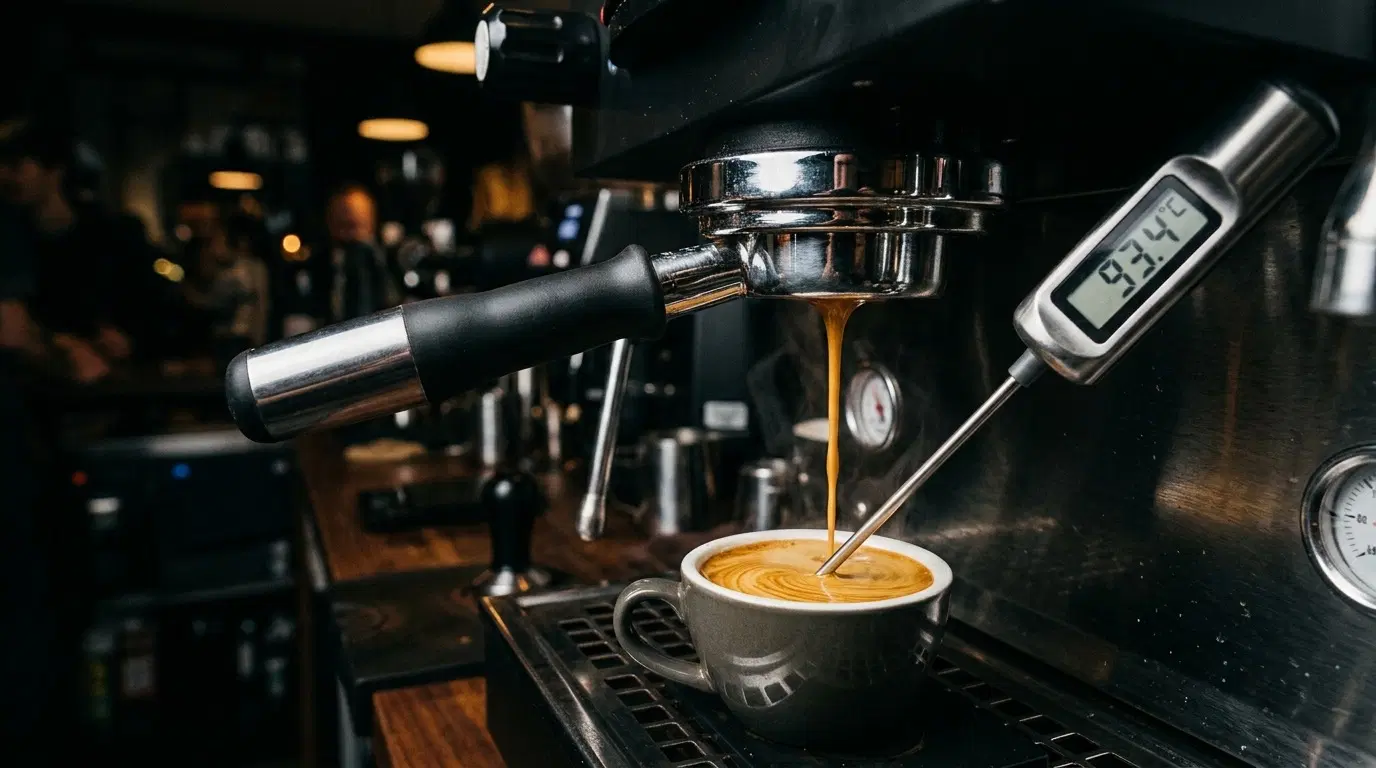
Between 90°C and 96°C at the group head. Most automatic machines are set around 93°C, which is optimal. High-end machines allow degree-precise adjustment.
Key facts
4 buying criteria · 5 detailed comparisons
Temperature & Extraction: The Secrets of Perfect Coffee
Behind every cup of coffee lies chemistry. Extraction — the process by which water dissolves the soluble compounds from ground coffee — is the key that separates exceptional coffee from mediocre coffee. Understanding the variables gives you the power to correct and optimise every cup.
What Is Extraction?
Roasted coffee contains approximately 30% soluble compounds. Hot water extracts a portion of them. The goal: extract 18-22% of these compounds (the sweet spot identified by the Specialty Coffee Association).
| Extraction Rate | Result | Taste |
|---|---|---|
| < 18% | Under-extraction | Acidic, sour, watery, salty |
| 18-22% | Optimal extraction | Balanced, sweet, complex |
| > 22% | Over-extraction | Bitter, astringent, dry, burnt |
The compounds dissolve in a specific order:
- Acids (extracted first) — acidity, fruitiness
- Sugars (middle of extraction) — sweetness, caramel
- Bitterness (extracted last) — dark chocolate, then astringence
A good coffee captures the acids AND the sugars while limiting excessive bitterness.
Variable 1: Water Temperature
Temperature is the most impactful and easiest variable to control.
The Optimal Range: 90-96°C
| Temperature | Effect |
|---|---|
| < 85°C | Severe under-extraction. Flat and acidic coffee. |
| 85-89°C | Slight under-extraction. Acceptable for dark roasts. |
| 90-93°C | Lower ideal zone. Sweetness, less bitterness. Ideal for dark roast. |
| 93-96°C | Upper ideal zone. Complete extraction. Ideal for light/medium roast. |
| > 96°C | Over-extraction. Bitterness, astringence, burnt taste. |
| 100°C | Boiling water. NEVER pour boiling water over coffee. |
Practical Rule
- Dark roast → Lower temperature (90-92°C) — Compensates for natural bitterness
- Medium roast → Medium temperature (92-94°C)
- Light roast → Higher temperature (94-96°C) — Helps extract sugars
Tip without a thermometer: Boil water, then wait 30-60 seconds. You'll be in the 90-96°C range.
Variable 2: The Grind
Grind size determines the surface area of contact between water and coffee. The finer the grind, the faster and more intense the extraction.
| Method | Grind | Reference Size |
|---|---|---|
| Turkish coffee | Ultra-fine | Powder, like talc |
| Espresso | Fine | Table salt |
| Moka pot | Medium-fine | Caster sugar |
| Filter / V60 | Medium | Sand |
| French press | Coarse | Coarse salt |
| Cold brew | Very coarse | Cracked pepper |
The rule: If your coffee is too bitter → coarser grind. If your coffee is too acidic → finer grind.
Variable 3: The Coffee-to-Water Ratio
The ratio (coffee dose vs. water quantity) is the second pillar of extraction.
Standard Ratios
| Method | Ratio | Example |
|---|---|---|
| Espresso | 1:2 | 18g coffee → 36g in cup |
| Ristretto | 1:1.5 | 18g coffee → 27g in cup |
| Lungo | 1:3 | 18g coffee → 54g in cup |
| Filter/V60 | 1:15 to 1:17 | 15g coffee → 250ml water |
| French Press | 1:15 | 30g coffee → 450ml water |
| Moka pot | Fill the basket | Fixed dose by model |
| Cold brew | 1:8 | 100g coffee → 800ml water |
The principle: The more water you use per gram of coffee, the further extraction is pushed. A 1:18 ratio extracts more than 1:15.
Invest in a Scale
A precision scale (0.1g) is the most transformative tool for improving your coffee. It costs $16 and lets you reproduce exactly the same cup every day.
🛒 → See coffee scales on Amazon
Variable 4: Contact Time
The time water is in contact with coffee directly influences the extraction rate.
| Method | Optimal Time |
|---|---|
| Espresso | 25-35 seconds |
| AeroPress | 1-2 minutes |
| V60 | 2:30-3:30 minutes |
| Moka pot | 4-5 minutes (medium heat) |
| French Press | 4 minutes |
| Chemex | 3:30-4:30 minutes |
| Cold brew | 12-24 hours |
Time too short = under-extraction (acidic). Time too long = over-extraction (bitter).
In espresso, time is controlled by the grind: finer grind = water passes more slowly = longer time.
Variable 5: Water Quality
Water makes up 98% of your cup of coffee. Its chemical composition directly influences the taste.
What You Need to Know
- Ideal TDS (Total Dissolved Solids): 75-150 ppm
- Ideal pH: 6.5-7.5 (neutral)
- Calcium: Necessary for extraction, but causes limescale
- Chlorine: Kills aromas. Use filtered water.
Water too soft (< 50 ppm): Under-extraction, flat coffee Water too hard (> 200 ppm): Over-extraction, chalky coffee + limescale
Simple solution: A filtering jug (Brita) is sufficient for most cases.
The Diagnostic Guide
Your coffee isn't good? Here's how to fix it:
Coffee Too Acidic / Sour
→ Under-extraction. Solutions:
- Finer grind
- Higher temperature
- Longer contact time
- More water (higher ratio)
Coffee Too Bitter / Astringent
→ Over-extraction. Solutions:
- Coarser grind
- Lower temperature
- Shorter contact time
- Less water (lower ratio)
Coffee Flat / Watery
→ Under-dosed or under-extracted. Solutions:
- Increase the coffee dose
- Finer grind
- Check coffee freshness (> 2 months = flat)
Coffee Perfect But Inconsistent
→ Lack of precision. Solutions:
- Use a scale (dose to the gram)
- Time your extraction
- Control the temperature
- Use the same water
The Perfect Espresso: The Base Recipe
For those who want a reliable starting recipe:
| Parameter | Value |
|---|---|
| Dose | 18g |
| Yield | 36g in cup |
| Ratio | 1:2 |
| Time | 25-30 seconds |
| Temperature | 93°C |
| Grind | Fine (adjust if outside time target) |
Start with this recipe and adjust one variable at a time:
- Too acidic → finer grind OR temperature +1°C
- Too bitter → coarser grind OR temperature -1°C
- Too weak → increase dose (19g)
- Too intense → decrease dose (17g)
Why 92-96°C Is the Sweet Spot (And Why 100°C Is Wrong)
While the Specialty Coffee Association (SCA) defines the optimal brewing range as 90-96°C (195-205°F), our lab and taste tests consistently find the true magic happens between 92°C and 96°C (198-205°F). The common advice to "use boiling water" is a myth that actively harms your coffee. Water at 100°C (212°F) is far too aggressive for ground coffee. It causes thermal shock, immediately scalding the grounds and extracting harsh, bitter compounds (phenols and catechols) before the sweeter, more desirable elements have a chance to dissolve properly. This flash extraction also vaporizes many of the delicate aromatic oils that give coffee its complex fragrance and flavor, resulting in a cup that smells and tastes flat or burnt.
If you're using a standard kettle without temperature control, like a basic Bodum Ottoni, simply let it rest for 30 to 60 seconds after it clicks off. This will allow the temperature to drop from a scorching 100°C to a much more forgiving 95-96°C. This single, simple step can dramatically reduce astringency and reveal the hidden sweetness in your beans. Remember, the goal is to coax flavors out, not to boil them out.
Bean Roast Level: Light, Medium, and Dark Need Different Temperatures
A single temperature setting doesn't work for all coffees. The roast level of your beans dictates their density and solubility, requiring you to adjust your water temperature for a balanced extraction. Think of it as cooking: you wouldn't use the same oven temperature for a delicate fish as you would for a dense root vegetable.
-
Light Roasts: These beans are the densest and least soluble. Their complex, fruity, and floral notes are locked inside. To properly extract these flavors and avoid a sour, vegetal cup, you need more thermal energy. We recommend brewing light roasts at the higher end of the spectrum, typically 94-96°C (201-205°F).
-
Medium Roasts: This is where most specialty coffee lives. The beans are well-developed, with a balance of acidity and sweetness. The standard 92-94°C (198-201°F) range is perfect here, allowing you to extract the full spectrum of caramel, chocolate, and fruit notes without introducing excessive bitterness.
-
Dark Roasts: The roasting process makes these beans more brittle, porous, and highly soluble. Their flavor profile is dominated by roasty, bitter, and dark chocolate notes. Using hot water on dark roasts is a recipe for an ashy, acrid cup. To tame their inherent bitterness, drop the temperature to 88-92°C (190-198°F). This gentler heat extracts the deep, rich flavors without scorching the delicate structure.
| Roast Level | Recommended Temperature | Rationale |
|---|---|---|
| Light | 94-96°C (201-205°F) | High energy needed for dense, less soluble beans. |
| Medium | 92-94°C (198-201°F) | The ideal balance for most specialty coffees. |
| Dark | 88-92°C (190-198°F) | Lower energy prevents scorching of porous, highly soluble beans. |
Brew Method Matrix: Espresso, V60, French Press, AeroPress
Your brewing equipment fundamentally changes the physics of extraction. Immersion, percolation, and pressure-driven methods each demand a unique approach to temperature and ratio to achieve optimal results.
-
Espresso: Here, 9 bars of pressure force water through a finely-ground puck of coffee in just 25-35 seconds. Temperature stability is paramount. A machine like the Breville Barista Express uses a Thermocoil system to hit its target of 93°C (200°F). High-end machines like the La Marzocco Linea Micra use PID-controlled boilers to maintain that temperature with less than a degree of variance. The standard starting ratio is 1:2 (e.g., 18g of ground coffee yields 36g of liquid espresso).
-
V60 (Pour-Over): This percolation method requires a higher starting temperature to compensate for heat loss as water passes through the grounds and dripper. For a light roast, we start at 96°C (205°F) with a 1:16 ratio (22g coffee to 352g water). The constant flow of fresh, hot water is key to extracting the delicate notes before the brew bed cools significantly.
-
French Press: As a full immersion method, the grounds and water steep together for around 4 minutes. The slurry will naturally cool over this time. To counteract this, begin with a slightly hotter water temperature, around 94°C (201°F). A coarser grind is necessary to avoid a muddy cup, and a common ratio is 1:15 (30g coffee to 450g water).
-
AeroPress: This versatile hybrid brewer can be used in countless ways. For a standard, pressure-assisted brew, a lower temperature of 85-90°C (185-195°F) works wonderfully, as the final plunge provides extra extractive force. For an inverted, full-immersion style, treat it like a small French Press and start closer to 93°C. Ratios are recipe-dependent but often fall in the 1:14 range.
Diagnosing Over- and Under-Extraction by Taste
Learning to taste your coffee critically is the fastest way to improve your brewing. Go beyond simply "good" or "bad" and identify the specific sensory clues that point to extraction issues. Your palate is the most sensitive diagnostic tool you own.
Under-Extraction: The Sour Problem This is what happens when you don't pull enough of the good stuff out of the coffee. The first compounds to dissolve are acids, so an under-extracted brew is dominated by them.
- Taste: The defining characteristic is a sharp, aggressive sourness, like biting into an unripe piece of fruit. It can also have a distinct salty note. The coffee lacks sweetness and depth; flavors feel thin and disconnected.
- Mouthfeel: It feels watery and lifeless on the palate. There's no satisfying weight or lingering aftertaste.
- How to Fix: Grind finer to increase surface area, raise your water temperature to increase solubility, or extend your brew time to give the water more contact with the coffee.
Over-Extraction: The Bitter End This is the result of pulling too much from the grounds, including the unpleasant compounds that dissolve last.
- Taste: An overwhelming and harsh bitterness that is distinct from the pleasant bitterness of dark chocolate. It's often accompanied by an astringent, drying sensation. All the nuanced, sweet, and acidic notes have been obliterated, leaving a generic "roasty" or "burnt" flavor.
- Mouthfeel: The defining trait is astringency—that same drying, chalky feeling you get from over-steeped black tea. It makes you want to immediately drink a glass of water.
- How to Fix: Grind coarser to reduce surface area, lower your water temperature to be less aggressive, or shorten your brew time.
Equipment That Matters: PID Boilers, Pour-Over Kettles, and Thermometers
Consistent results require consistent variables, and temperature is the most critical. While you can make good coffee with basic gear, investing in equipment that offers precise thermal control is the single biggest hardware upgrade you can make.
-
PID Controllers: Found in premium espresso machines, a PID (Proportional-Integral-Derivative) controller is a micro-computer that maintains exact boiler temperatures. A basic machine with a standard thermostat, like an entry-level De'Longhi, might swing by 5-10°C. In contrast, a PID-equipped machine like the Rancilio Silvia Pro X holds its temperature to within a single degree. This rock-solid stability eliminates temperature as a variable, allowing you to produce consistently delicious shots. Even super-automatic machines like the Jura E8, which use fast-heating thermoblocks, benefit from sophisticated internal sensors to manage temperature, though they lack the raw stability of a PID boiler.
-
Variable Temperature Kettles: For any manual brewing method (V60, French Press, AeroPress), a variable temperature gooseneck kettle is a non-negotiable tool for serious brewers. Models like the Fellow Stagg EKG (around $167) or the Brewista Artisan (around $151) allow you to set your target temperature to the degree and hold it there. This means you can brew a delicate light roast at a precise 96°C and a robust dark roast at 90°C, all with the push of a button.
-
Instant-Read Thermometers: If a new kettle isn't in the budget, a quality digital thermometer is a fantastic, low-cost alternative. For under $25, a model like the ThermoPro TP19 can give you an accurate reading of your water temperature after it has rested off the boil. You can also use it to measure the temperature of the slurry in your French Press mid-brew, giving you valuable data on heat loss. It’s the simplest way to move from guessing to knowing.
Conclusion
Coffee extraction is an accessible science. Temperature, grind, ratio, time, and water quality: these five variables are the levers that transform ordinary coffee into a sensory experience. No need for $2,160 equipment — a temperature-controlled kettle, a scale, and a good grinder are enough to achieve excellence.
The best advice: change only one variable at a time. Taste, adjust, repeat. Within a few days, you'll produce coffee better than 90% of restaurant coffee.
📧 Never miss a coffee deal
Sign up to get our expert reviews and promo alerts straight to your inbox.
🔒 Join 5,000+ readers — By signing up, you agree to our privacy policy.
Related guides
Articles similaires

Christmas Coffee Gift Guide 2026: Best Ideas to Give
Christmas 2026 coffee gifts: the best capsule machine sets, bean-to-cup machines, premium coffee beans and barista accessories. Selection by budget, with the lowdown on Black Friday deals.
Lire l'article →
2026 Study: The Real Cost of a Cup of Coffee at Home
What does a cup of coffee at home really cost in 2026? Study based on real prices: automatic bean 0,28 €, capsules 0,55 €, filter 0,47 €, moka 0,36 €. Bean machine vs capsules break-even: 17 months.
Lire l'article →
Best Coffee Beans 2026: Tested in Real Conditions
Best coffee beans 2026: Lavazza, illy, Nespresso Original and compatible capsules put to the test. Selection by use, budget and machine — the guide to choosing a coffee that changes your daily routine.
Lire l'article →