Affiliate links: we earn a commission on purchases, at no extra cost to you.
Our top 3 picks at a glance
149-179€
See deal →149-179€
See deal →29-39€
See deal →The best pick for your needs
| Best overall | Baratza Encore Conical Burr Grinder | 8.9/10 | 149-179€ |
| Best value | Hario Mini Mill Slim | 8.1/10 | 29-39€ |
| Best premium | Wilfa Uniform WSCG-2 | 8.8/10 | 149-179€ |
| Highest rated | De'Longhi KG79 moulin | 7.8/10 | 49-69€ |
Best Coffee Grinders 2026: 5 Tested, Burr vs Blade
Best coffee grinder 2026: we tested 8 burr and blade grinders for espresso, pour-over and French press — ranked by grind consistency, noise and value. Find yours and today's best price.
In brief
Our verdict
The Baratza Encore is THE reference under $108 for serious coffee lovers: conical steel burrs, 40 grind settings, consistent results for filter and espresso. For tight budgets, the Krups GVX231 at $38 offers unbeatable value for money.
Top pick
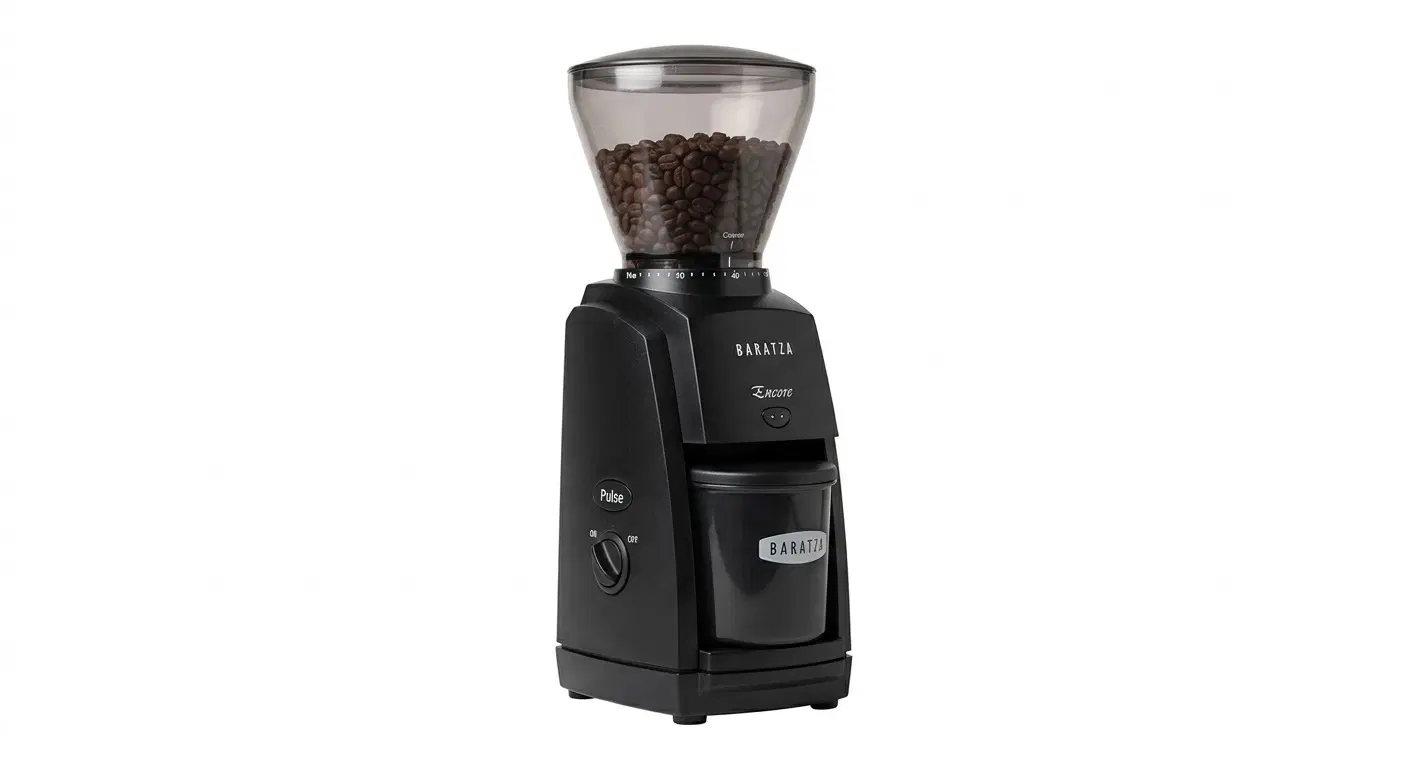
Baratza Encore Conical Burr Grinder
8.9/10 · €149.00 – €179.00
Budget pick
Hario Mini Mill Slim
€29.00 – €39.00
Best rated
Wilfa Uniform WSCG-2
8.8/10 · €149.00 – €179.00
Premium pick
De'Longhi KG79 moulin
from €74.99
Key facts
5 products compared · 5 evaluation criteria · Average rating of the selection: 8.2/10 · Selection updated Aug 26, 2026
Products compared
Best Coffee Grinders 2026
Grinding your own coffee is the most impactful transformation for the quality of your cup. Freshly ground coffee develops incomparable aromas compared to any pre-packaged powder. And good news: you don't need to spend a fortune to get excellent results.
| Critère | Top choixBaratza Encore Conical Burr GrinderBaratza | Krups GVX231 ExpertKrups | De'Longhi KG79 moulinDe'Longhi | Hario Mini Mill SlimHario | Wilfa Uniform WSCG-2Wilfa |
|---|---|---|---|---|---|
| Prix | 149-179€ | 39-59€ | 49-69€ | 29-39€ | 149-179€ |
| Type | Moulin à meules coniques | - | - | - | - |
| Meules | Coniques 40mm | - | - | - | - |
| Réglages | 40 niveaux | - | - | - | - |
| Puissance | 250 W | - | - | - | - |
| Capacité | 230g | - | - | - | - |
| Note globale | 8.9/10 | 7.6/10 | 7.8/10 | 8.1/10 | 8.8/10 |
| Acheter | Check current price → | Check current price → | Check current price → | Check current price →Lire notre test → | Check current price →Lire notre test → |
Understanding Grinder Types
Blade Grinders (To Avoid)
These devices look like mini-choppers and usually cost $16-27. Do not buy them for good coffee. The grind is extremely uneven (fine powder mixed with large chunks), making correct extraction impossible.
Conical Burr Grinders
Conical burrs grind coffee between two metal cones. Result: uniform grind, low heat, less noise. This is the recommended type for virtually all domestic use.
Flat Burr Grinders
Produce an even more uniform grind, ideal for precision espresso. Flat burr grinders under $108 exist but are less common and less durable than conical ones.
Our Top 5 Grinders Under $108
| # | Grinder | Price | Burr Type | Settings | Ideal For |
|---|---|---|---|---|---|
| 🥇 | 🛒 Baratza Encore | ~$107 | Steel conical | 40 | Filter, V60, French press |
| 🥈 | 🛒 Krups GVX231 | ~$38 | Flat burrs | 17 | Filter, basic espresso |
| 🥉 | 🛒 De'Longhi KG79 | ~$49 | Flat burrs | 18 | Filter, capsules, percolator |
| 4 | 🛒 Hario Mini Mill | ~$43 | Ceramic conical | ∞ (manual) | Travel, V60, Aeropress |
| 5 | 🛒 Wilfa Uniform | ~$103 | Steel conical | 24 | Filter, specialty coffee |
1. Baratza Encore — The Absolute Reference
The Baratza Encore is considered the best grinder under $216 by the global coffee community. Designed in Finland, built with 40mm treated steel conical burrs, it offers 40 grind settings.
What makes it exceptional:
- Extremely uniform grind for this price
- 40 settings (from coarse filter to near-espresso)
- Spare parts available (repairable brand)
- Practical transparent bin
- Renowned Baratza after-sales service
Advantages:
- Best grind quality in this price range
- Durable (can last 10+ years with maintenance)
- Ideal for filter, V60, Chemex, French press
- Active community and numerous tutorials
Disadvantages:
- At the limit of our budget ($107)
- Not optimal for precision espresso (prefer Baratza Sette)
- Somewhat dated design
Verdict: If you can stretch your budget to $107, the Baratza Encore is the smartest purchase possible. It will last for years and radically improve your coffee.
2. Krups GVX231 — Best Value for Money
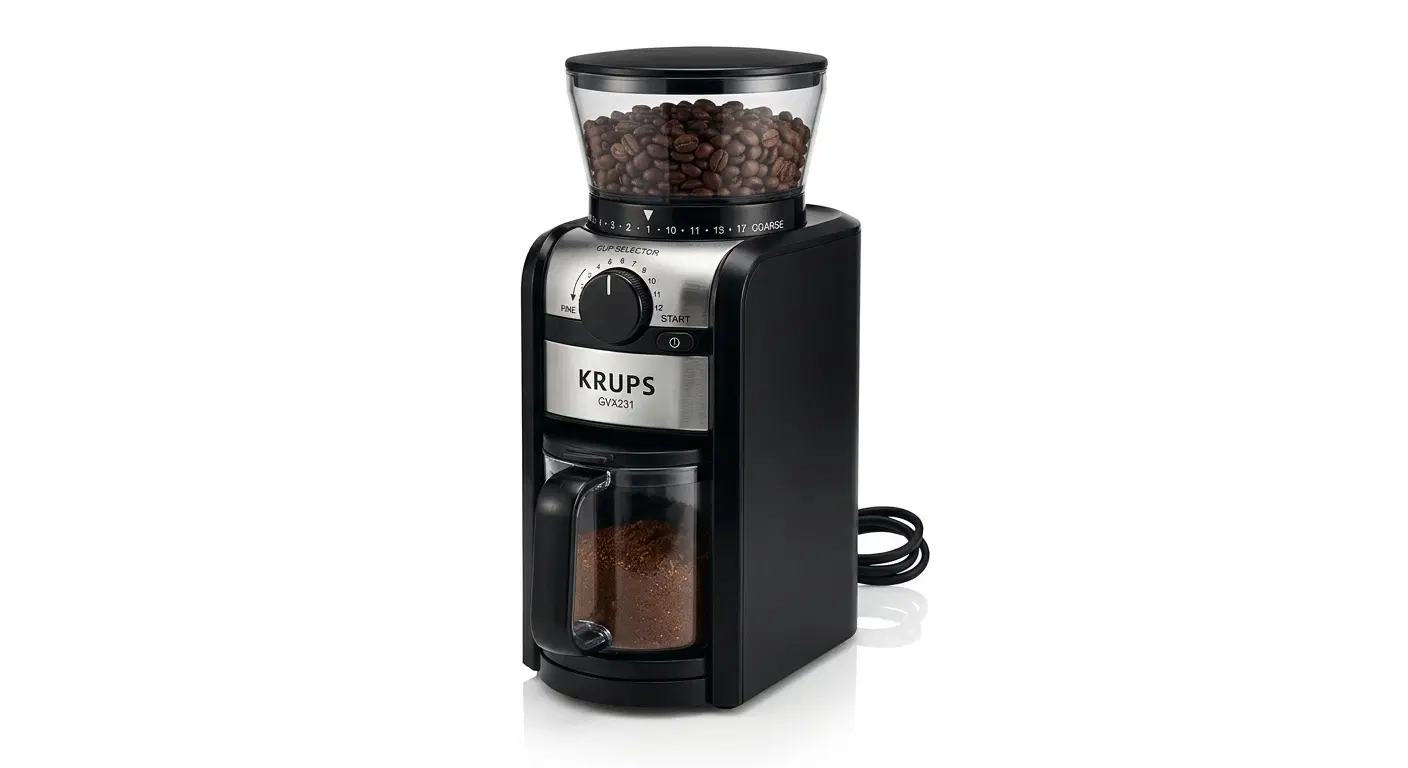
For a first grinder at a low price, the Krups GVX231 is surprising. Its 17 grind levels and flat steel burrs produce a decent grind for filter coffee and capsule machines (ground coffee).
Advantages:
- Very accessible price (~$38)
- 17 grind settings
- Built-in timer for automatic dosing
- Easy to clean
Disadvantages:
- Less uniform grind than the Baratza
- Relatively noisy
- Shorter lifespan (3-5 years with daily use)
3. De'Longhi KG79 — The Versatile Option
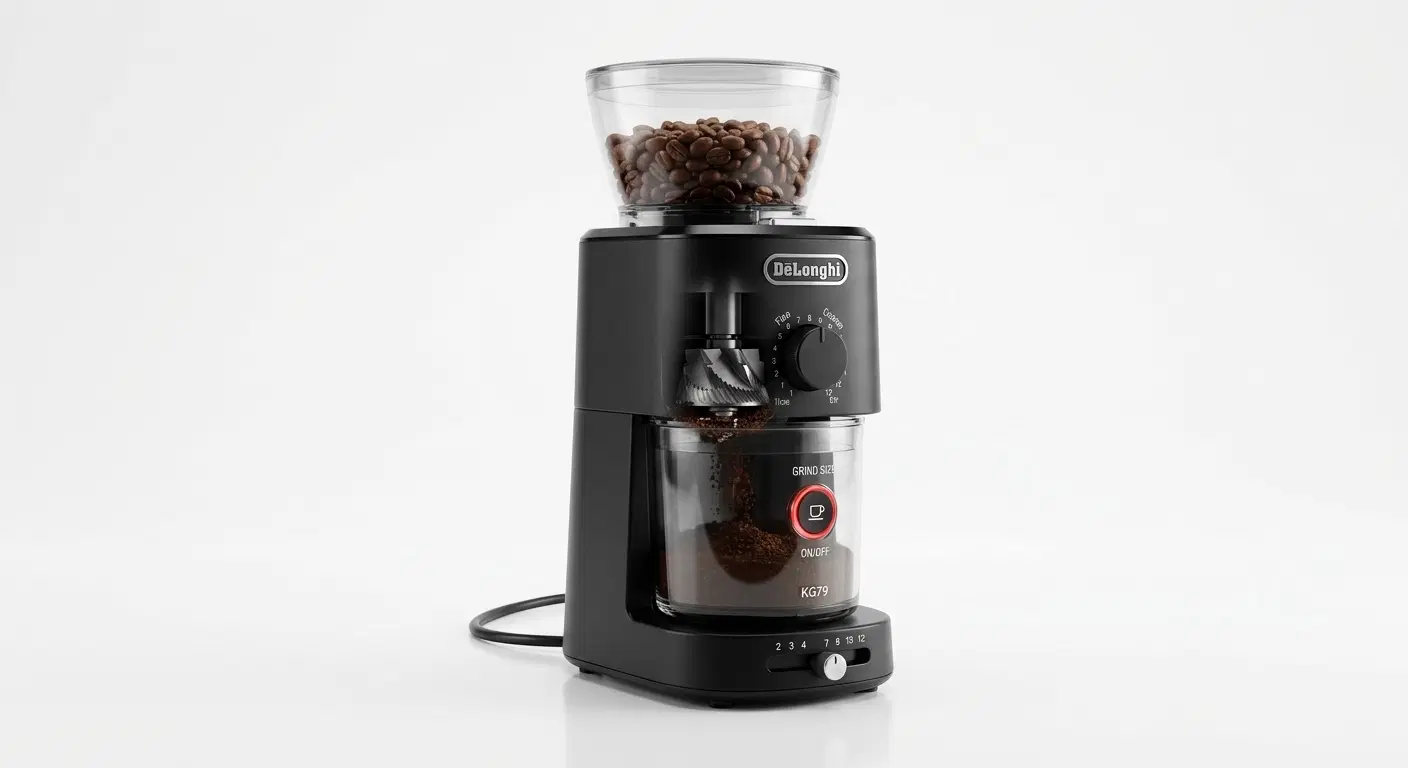
The De'Longhi KG79 is a solid all-rounder with 18 grind levels and a 120g bin. Compatible with espresso machines, filter machines, and percolators. Its robustness and De'Longhi's reputation make it a reassuring choice.
Advantages:
- Reliable brand with accessible after-sales service
- 18 grind levels
- Large coffee bin (120g)
- Refined design
Disadvantages:
- Less precise grind than the Baratza Encore
- Plastic-dominated construction
4. Hario Mini Mill — The Travel Champion
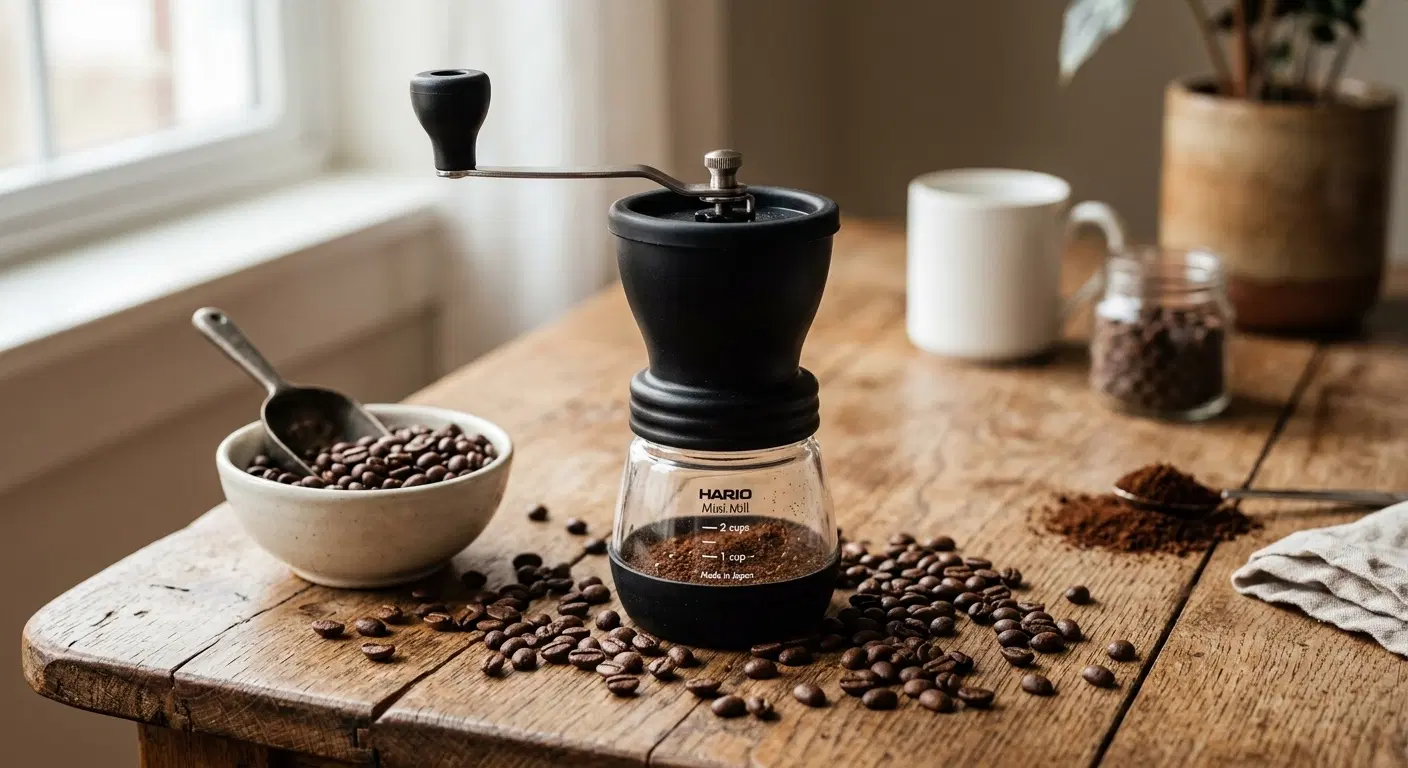
For coffee lovers on the go, the Hario Mini Mill is an icon. This Japanese manual grinder uses ceramic conical burrs and produces an impeccable grind for V60 and Aeropress.
Advantages:
- Exceptional ceramic grind (durable, anti-heating)
- Compact, perfect for travel
- Silent
- Infinite grind adjustment
Disadvantages:
- Manual effort required (~2 minutes for 20g)
- Not practical for daily home use
5. Wilfa Uniform — The Quality Scandinavian
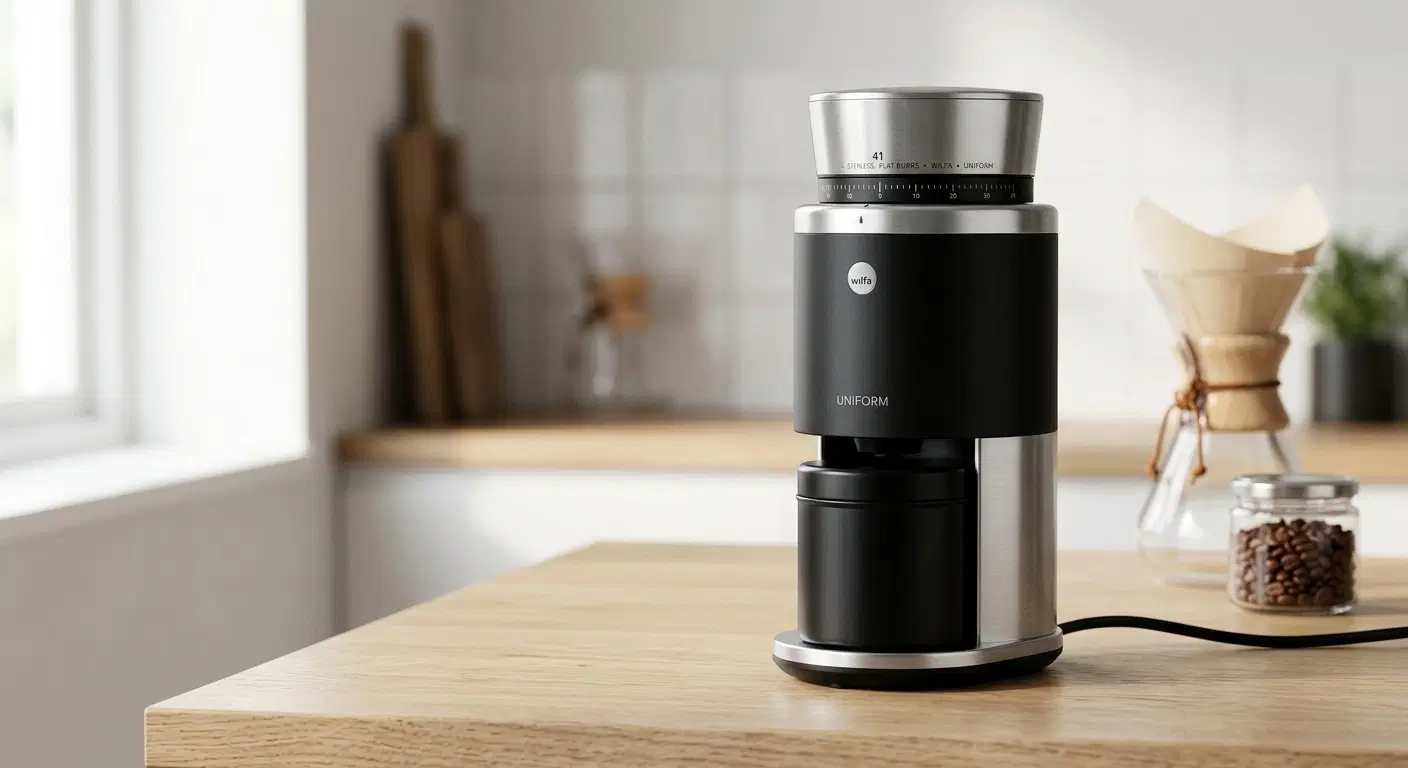
Designed by Wilfa (a Norwegian brand praised by world barista champions), the Uniform offers 24 grind settings and 38mm steel conical burrs. Excellent for specialty filter coffee.
Advantages:
- Clean Scandinavian design
- Quality steel burrs
- Ideal for specialty coffee and gentle brewing methods
- Reasonable noise level
Disadvantages:
- Not as good as the Baratza for espresso
- High price within our budget
Which Grinder for Your Use?
| Use | Recommendation |
|---|---|
| Filter coffee / coffee maker | Baratza Encore or Wilfa Uniform |
| French press | Baratza Encore or Krups GVX231 |
| V60 / Chemex | Baratza Encore or Wilfa Uniform |
| Basic espresso | Krups GVX231 or De'Longhi KG79 |
| Travel / nomadic | Hario Mini Mill |
| First grinder on a budget | Krups GVX231 |
Burrs Explained: Conical vs Flat, Steel vs Ceramic
The heart of any burr grinder is, unsurprisingly, its burrs. The geometry and material of these components dictate the final quality of your ground coffee. Most consumer grinders under $200, like the Baratza Encore, use conical steel burrs. One cone-shaped burr sits inside another, creating a long, vertical grinding path. This design is energy-efficient, runs cooler at lower speeds, and tends to produce a "bimodal" distribution of grounds—a primary size with a smaller amount of fine particles. This can actually enhance body and texture in immersion brews like French press.
Flat steel burrs, found in prosumer models like the Fellow Ode or Eureka Mignon series, use two donut-shaped rings that sit parallel to each other. They produce a highly uniform, "unimodal" grind with fewer fines, which is prized for the clarity and precision required for perfect espresso extraction.
The material matters, too. Steel burrs are the industry standard for their sharpness and ability to produce a clean, consistent cut. Ceramic burrs, sometimes found in manual grinders, are harder and retain their edge longer but can be more brittle. In our tests, we find that for anything short of a high-volume commercial setting, a well-engineered set of steel burrs provides the best balance of performance and durability.
Grind Consistency Tests: Espresso vs Pour-Over vs French Press
A grinder’s quality is measured by its ability to produce uniformly sized particles for a specific brew method. We tested this by grinding the same beans for three distinct methods.
For espresso, consistency is non-negotiable. Uneven grounds, with a mix of powder and small chunks, lead to "channeling"—where water blasts through weak spots in the puck, creating a shot that's simultaneously sour and bitter. A proper espresso grind should feel like fine sand. While the Baratza Encore can get close, it lacks the micro-adjustments needed for dialing in a shot. A grinder like the Baratza Sette 270, which costs over $400, produces a visibly more uniform, fluffy grind essential for consistent 9-bar extractions.
For pour-over (V60, Chemex), the target is a medium grind resembling table salt. Too many "fines" (powdery dust) will clog the paper filter and over-extract, resulting in a bitter, muddy cup. The Wilfa Uniform, with its 58mm flat burrs, produced a remarkably clean brew bed with minimal silt, highlighting the coffee's acidity. The Krups GVX231, by contrast, left a noticeable layer of mud at the bottom of the filter.
For French press, you need a coarse grind like rough breadcrumbs. Fines are the enemy here, as they pass through the metal mesh filter and create sludge. In our side-by-side tests, the Baratza Encore delivered a coarse grind with far fewer fines than the De'Longhi KG79, resulting in a cleaner, more satisfying press.
Static, Retention, and Daily Cleaning Friction
Beyond grind quality, the daily user experience is defined by three annoyances: static, retention, and cleaning. Static is the enemy of a tidy coffee station. As beans are crushed, they generate a static charge, causing lightweight chaff and fine coffee particles to cling to everything. Plastic grounds bins, like the one on the De'Longhi KG79, are particularly bad offenders, creating a mess every time you pull them out. A quick pro tip is the Ross Droplet Technique (RDT): spritz your beans with a fine mist of water before grinding to nearly eliminate static.
Grind retention refers to the coffee that remains trapped inside the grinder after use. The Baratza Encore typically retains between 0.5 and 1.5 grams of grounds in its chute. This means the first part of your next brew will be made with stale, day-old coffee. While minimal for drip coffee, this is a major issue for espresso. High-end, "zero-retention" grinders like the Niche Zero (around $702) are designed to solve this, but for budget grinders, a few quick taps or a puff from a bellows can help clear the chamber. A simple workflow habit is to grind and discard a gram or two of beans before your first real dose of the day.
Hand Grinders vs Electric: When Manual Wins
While electric grinders offer speed and convenience, a high-quality manual grinder is often the smarter choice in specific scenarios. For a budget under $200, the grind quality of a top-tier hand grinder often surpasses its electric counterparts. For example, the 1Zpresso JX-Pro (around $162) features large, 48mm steel burrs and a micro-stepped adjustment system that delivers the precision needed for true espresso—a feat that electric grinders typically can't match until you reach the $400 price point. The build quality is also superior, often featuring all-metal construction compared to the plastic bodies of entry-level electric models.
Portability is another key advantage. You can't pack a 3.1 kg Baratza Encore in your carry-on, but a Hario Mini-Mill or an Aergrind fits easily, ensuring you have great coffee while traveling. Finally, there's the noise factor. An electric grinder can easily hit 80-85 dB, loud enough to wake up the house. A hand grinder is virtually silent, making it perfect for the early-morning coffee ritual. The trade-off is effort: grinding 25 grams for a pour-over can take a full minute of work, a task the Encore accomplishes in about 15 seconds. For convenience, electric always wins; for value and quality-per-dollar, manual is a serious contender.
Common Pitfalls: Setting Drift, Stale Beans, Coarse-Grind Surprises
Even the best grinder can't overcome poor technique or bad ingredients. One common issue we see is setting drift. On grinders with fewer detents or simpler mechanics, motor vibrations can cause the grind setting to slowly shift coarser over time. We noticed this on some older, heavily used Krups models. It's a good habit to quickly verify your grind setting before each use. On stepped grinders like the Baratza Encore, ensure the bean hopper is twisted firmly into the locked position, as a loose hopper is the number one cause of inconsistent results.
Another pitfall is using stale, oily beans. A grinder is not a magician. Coffee that was roasted three months ago will taste flat and woody, no matter how perfectly it's ground. Worse, the oils from super-dark, stale roasts can coat the burrs, attracting fine particles and eventually jamming the mechanism. Always use beans within a few weeks of their roast date and store them in an airtight container, not in the hopper. The hopper is a staging area, not a long-term storage vessel.
Finally, be aware of coarse-grind surprises. Many grinders are optimized for the medium-fine range (drip to AeroPress). When you push them to their absolute coarsest settings for French press or cold brew, their consistency can plummet, producing a chaotic mix of boulders and dust. The Baratza Encore performs admirably here, but many cheaper models simply can't maintain uniformity at the coarse end of their range.
FAQ
Blade or conical burrs: what's the difference? Blade grinders produce uneven grounds, poorly suited for good coffee. Conical or flat burrs give uniform grounds essential for proper extraction.
Does a grinder really change the taste? Yes, considerably. Freshly ground coffee releases its aromas within 15 minutes. It's the best improvement possible for your coffee.
Can you make espresso with a grinder under $108? The Baratza Encore handles basic espresso. For precision espresso, budget $162-216.
How to clean a coffee grinder? Run cleaning pellets (like Grindz) through regularly. Clean the bin with a brush. Avoid water on the burrs.
Conclusion
For under $108, the Baratza Encore is unquestionably the best investment if you want maximum quality. For an affordable first grinder that already radically changes the taste of your coffee, the Krups GVX231 at $38 is ideal.